




















































































Oregon State University’s Student Competition Rocketry Team launched a test flight of its “Heat-Seeking Beaver” rocket 6,600 feet over the central Oregon desert on Oct. 18.
The 4-inch diameter rocket is used to test at a sub-scale before designing the large-scale competition rocket. “Heat-seeking Beaver” featured a clear nose dome, so the team could record the launch with a GoPro camera.
“(The nose dome) kind of looks like a heat seeker for an AIM-9 heat-seeking missile,” team lead, Cody Eutsler said. “We want to make sure that people know we’re not trying to do that. We built these rockets with the idea that these are great scientific tools and a lot of people on the teams want to work on rockets for good.”
The scientific mission — carrying a payload experiment on the rocket — is one major component of SCRT’s goals for its launch at the International Rocket Engineering Competition.
This year’s payload is a CubeSat, a small satellite which will sit in the nosecone, and is being used as a prototype for a future climate modelling satellite.
At IREC — college rocketry’s biggest competition — hundreds of teams from around the world gather in Midlands, Texas. There are three categories to compete in based on target altitude: 10,000 feet, 30,000 feet and 45,000 feet.
The competition will take place in mid-June, 2026 with the OSU rocketry team conducting a test flight of the full scale rocket in April ahead of competition.
OSU competes in the 10,000 feet category. The main objective is to launch their 6-inch diameter and 10-foot-tall competition rocket as close to 10,000 feet above ground as possible.
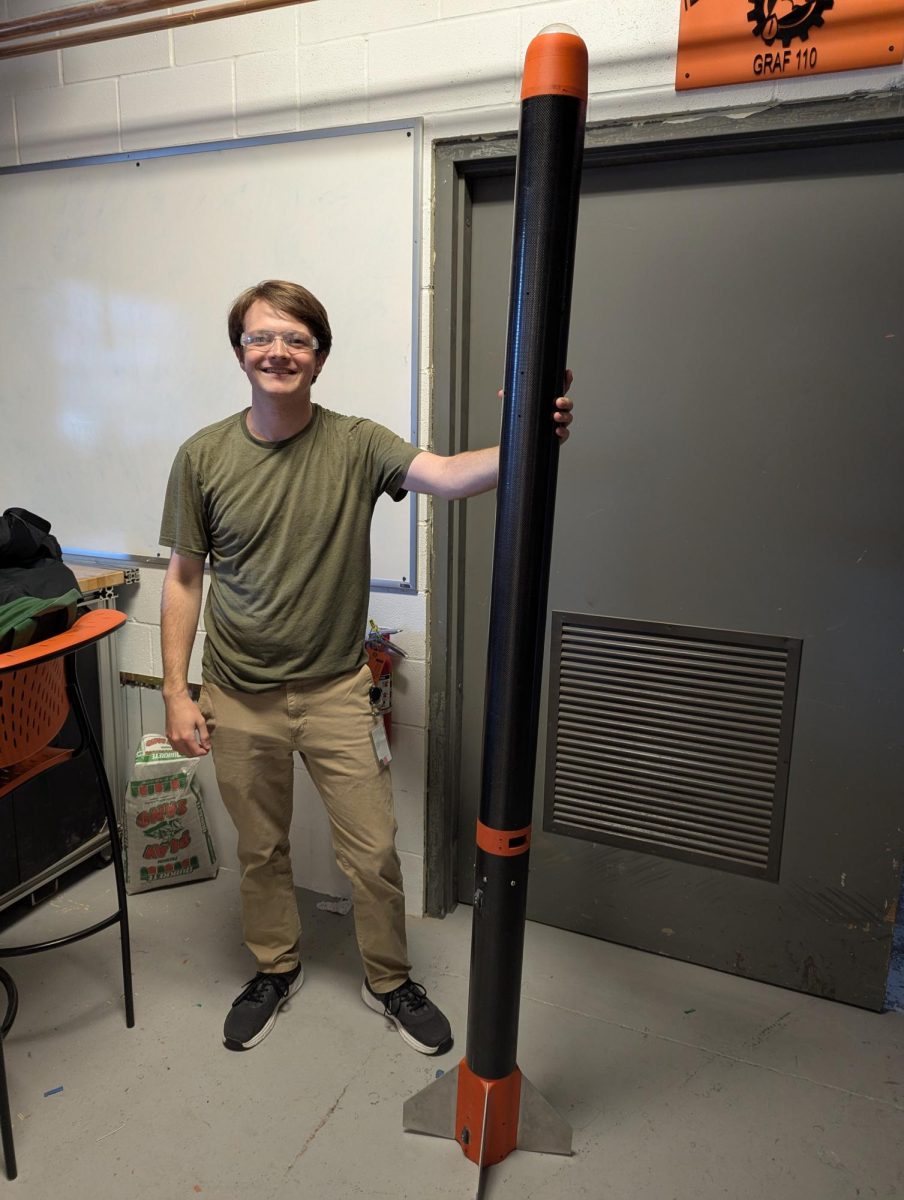
“We’re trying to hit exactly 10,000 feet above ground level,” said Mason Johnson, aerodynamics co-lead. “That’s really hard to simulate getting your masses and motor and everything exactly right because wind, air density… stuff just changes, and it’s really hard to simulate that. What we do on our team is we design the rocket to go higher than that, then we have the air brakes.”
Air brakes are small blades that extend from the side of the rocket to slow its ascent. The team writes code so that air brakes deploy at the right amount and at the right time. Test flights allow the team to compare computer simulations to reality.
“I can simulate stuff all day long in software, that doesn’t mean anything if I don’t know if it’s accurate or not. That’s why we need stuff like our flight of ‘Heat-Seeking Beaver,’” said Johnson.
Another major test for “Heat-Seeking Beaver” was a change from a single-separation dual-deployment recovery system to a dual-separation dual-deployment system. This means that instead of releasing the smaller drogue parachute and the main chute from the rocket at the same time, they are released separately.
Parachute deployment has caused the team grievances in the past. During the team’s 2024 launch at IREC, parachutes failed to deploy, causing the rocket to fall from 5,000 feet.
Eutsler describes the seamless launch and recovery of “Heat-Seeking Beaver” as a “redemption moment” for the team, giving it the confidence it needs going into competition.
“I really love rocketry because you’re putting hours and days and months of work into this thing,” Eutsler said. “You just have the ultimate test of you’re either going to get this back perfect, and you’re going to be happy, or you’re going to come back with a garbage bag of a rocket and you’re going to learn your lesson.”