
















































































Oregon State University’s research has made many important contributions to the United States.
OSU is one of only three universities in the US to hold Land, Space, Sea and Sun grants. In 1976, it became the first university in Oregon to hold the Carnegie Classification of Institutions of Higher Education’s highest research distinction, Research Universities I. Today it continues to maintain the highest designation, Research 1, which indicates very high research activity.
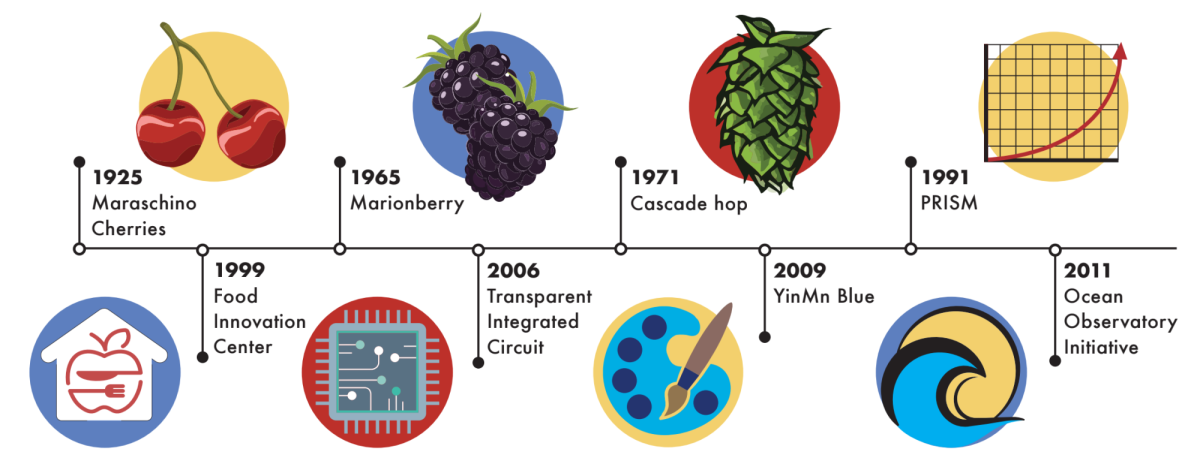
Maraschino cherries- 1925
Maraschino cherries were previously soaked in alcohol, which became illegal during prohibition in the 1920s. As a result, Ernest Wiegand, a professor of horticulture at OSU developed a new brine.
Marionberry- 1956
The marionberry was developed at OSU by the United State Department of Agriculture. OSU alumnus George F. Waldo helped to develop it. It is a cross between a Chehalem berry and Ollalieberry. More than 90% of the marionberries grown worldwide are grown in Oregon.
Cascade hop- released in 1971
The Cascade hop was developed at OSU by the USDA. It has become one of the most popular hop varieties for craft brewing in the US.
O. H. Hinsdale Wave Research Laboratory constructed- 1973
The Hinsdale Wave Lab has contributedto research about wave breaking, coastal structure stability and design optimization, sediment transport and ship maneuverability, among many other categories. In 2003, the Tsunami Wave Basin – now the Directional Wave Basin – was added. It is the largest tsunami simulator in the world.
PRISM- 1991
Created by OSU PhD student Chris Daly, Parameter-elevation Regressions on Independent Slopes Model is a computerized climate mapping system. In 2002, PRISM became the national standard for climate mapping.
Food Innovation Center- 1999
The Food Innovation Center was dedicated in Portland in 1999. It partners with the Oregon Department of Agriculture. Since its beginning, it has helped hundreds of companies across the country develop products by refining recipes, flavors, processes and packaging.
Transparent Integrated Circuit- 2006
OSU researchers developed the world’s first transparent integrated circuit, led by master’s student Rick Presley. OSU licensed Hewlett-Packard, an information technology company, to allow them to market new products based on the work done by these researchers.
YInMn Blue- 2009
OSU distinguished professor of chemistry Mas Subramanian, with the help of graduate student Andrew Smith, discovered the YInMn Blue pigment. It was the first discovery of a blue pigment since cobalt in 1802. In 2017 Crayola created a crayon inspired by YInMn Blue called “Bluetiful.”
Ocean Observatory Initiative- 2011
The Ocean Observatory Initiative was the largest ocean research project ever funded by the US government. The project was funded by the National Science Foundation, but research has been carried out by OSU and the University of Washington. OSU is in charge of the OOI data center, Coastal Endurance Array, sensors and autonomous vehicles.
Low-Frequency Gravitational Wave Detection- 2023
The first gravitational waves were detected in 2015, but in 2023, a team of researchers co-directed by OSU physics professor Xavier Siemens found evidence of low-frequency gravitational waves using radio pulsar timing.
Information courtesy of OSU Special Collections Archives, OregonLive, the Oregon Encyclopedia, the Oregon State University Newsroom, the College of Earth, Ocean and Atmospheric Sciences, the College of Engineering, PRISM and the Oregon Stater.