


















































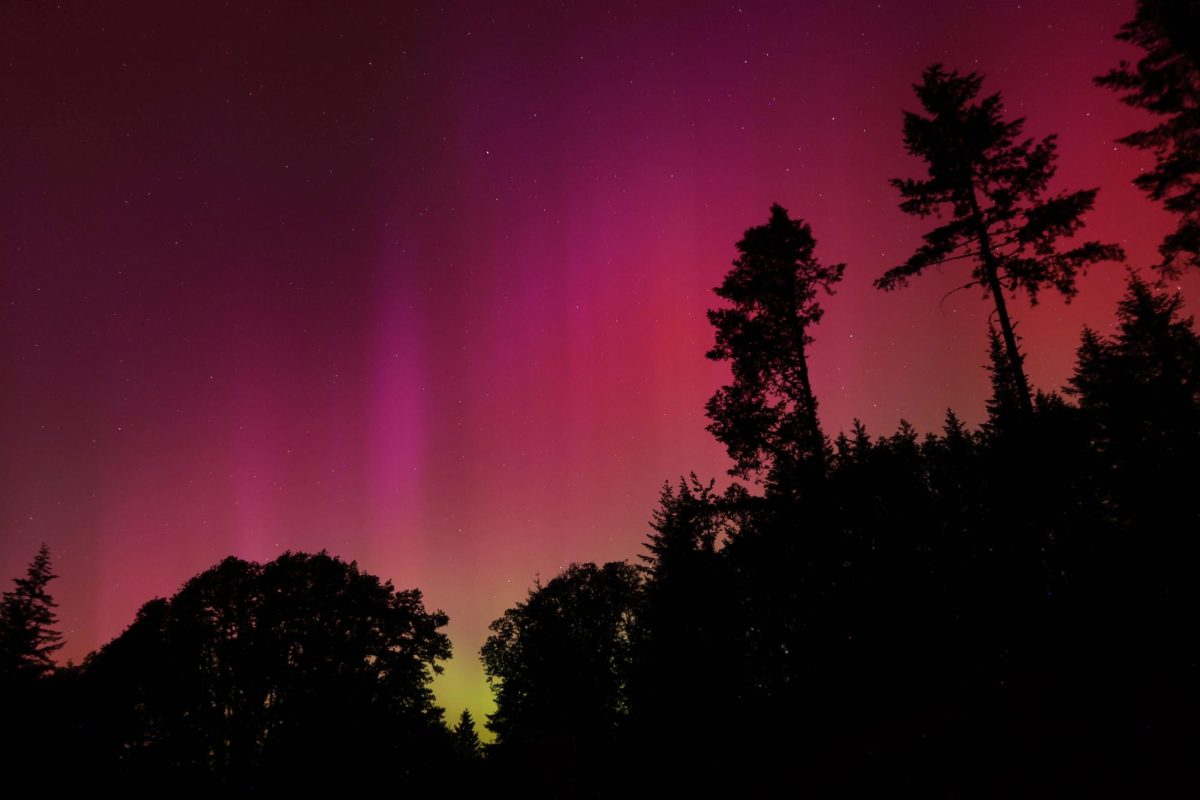








When you look up at the night sky, you’re seeing history.
By the time starlight reaches our eyes, we are catching a glimpse of how the universe appeared hundreds or even millions of years ago. In that sense, space has always been tied to the past.
Here on Earth, space is a pillar of both the past and the future, as generation after generation renews the very human passion to explore what lies beyond.
On April 6, four astronauts aboard NASA’s Artemis II mission made history when they reached the farthest distance humans have ever traveled, breaking the previous record set by Apollo 13 astronauts in 1970.
People across the globe tuned in to follow the monumental mission as it ushered in a new chapter of a classic American tale. With viewer counts in the millions according to NASA.
The American Space Age, which typically refers to the period between the late 1950s and the mid-1970s, peaked with the 1969 Apollo moon landing, which was watched by 723 million people worldwide, according to Royal Museums Greenwich.
Today’s students may not be watching the first moon landing, but we are coming of age in what feels like a second Space Age — one that is shaped not only by an ever-evolving technological landscape, but also by political and social unrest, environmental crisis and the question of where science fits into the larger narrative of American society.
Like the students of the 1960s and 70s, we are not only witnessing this new age, but we are shaping it.
The era of the Apollo moon landing is often remembered for innovation and national pride, but is also a time marked by a disconnect between the American populace and government. College campuses became nuclei of protests, particularly against the Vietnam War, with young adults spearheading the demand for change.
GenZ college students, including ones at Oregon State University, are no strangers to this tension.
In the spring of 2024, students at OSU and across the country assembled encampments to protest genocide in Palestine. In Jan, nearly 1,000 students across Corvallis K-12 schools walked out of class to protest immigration crackdowns led by U.S. Immigration and Customs Enforcement.
The broader political climate of the 70s also reflects the turbulent atmosphere of the 2020s.
Scandals like Watergate and the resignation of President Richard Nixon in 1974 defined the Space Age era, reflecting current-day political controversies like the Jan. 6 Capitol attack and multiple impeachment trials of Donald Trump.
Beyond the political scene, parallels between the decades extend to American climate anxiety and crisis.
The decades of the Space Age saw a growing concern for the environment with the release of Rachel Carson’s book Silent Spring in 1962, which became the major catalyst for the creation of the Environmental Protection Agency in 1970.
This environmental movement was driven largely by public pressure, particularly from student activists.
Today, young activists continue to drive the environmental movement with 32% of Gen Zs having either donated money, contacted an elected official, volunteered or attended a rally to address climate change in 2021, according to a survey conducted by Pew Research Center.
More recently, a 2024 study by the Yale Program on Climate Change Communication found that 63% of Americans are somewhat or very worried about global warming, and 71% believe it will harm future generations.
While Nixon caved to public pressure to form the EPA in the 70s, our current administration has stayed set on their agenda, maintaining a culture of climate denial and pulling back on environmental protections. This has been reflected in cuts to scientific research funding, including grants funding the work of OSU researchers.
Today, despite a renewed vigor for rapid technological advancement as seen in the artificial intelligence boom and private sector space exploration, there is simultaneously a growing skepticism toward science in the political sphere.
In a time when leaders are turning their back on science, attention demanding moments like Artemis II are an essential reminder of why scientific discovery still matters and that we as Americans are still capable of progress.
Space exploration didn’t stop with the moon landing and neither did social change. The need for students to raise their voices and demand forward motion is still as important as ever.
We not only have to ask ourselves what we can achieve, but ask ourselves what we should achieve and demand those results.
The original Space Age wasn’t defined solely by rockets or spacesuits, but by the people — especially students — who spoke up and spoke out for what they believed in.
We must do the same.
The question isn’t whether we are in another Space Age, rather it is if our generation will shape this age as boldly as the last. We have the opportunity to not only challenge the boundaries of space, but also the systems that define progress down here on Earth.