
































































Foggy hills shroud sheep and horses roaming in pastures, cared for by live-in caretakers and other workers.
This might sound like a faraway land, but the sheep and horse centers, two of several Oregon State University agricultural centers, are located a few miles off campus. They employ student workers and engage in research and education activities.
According to Turner Lear, the manager of the Sheep Research Center, the center cares for around 115 sheep with a focus on research and teaching.
Current research focuses include forage grazing patterns of sheep under solar panels on SW Campus Way and veterinary school biomedical research.
According to Lear, 600 to 800 students, from first-term freshmen to veterinary graduate students, visit the sheep center annually through their courses and the center is home to university sheep production courses.
Sheep are also ferried to campus events, county and state fairs and sold to Future Farmers of America clubs.
The sheep center has six student employees, spanning majors and experience in animal production, two of whom live on site.
One student employee, Emma Camp, a second-year forest engineering student, originally started volunteering for the center during lambing season last year, the time when female sheep give birth.
As a fifth-generation rancher, Camp grew up raising animals and showed a sheep in FFA.
“I came to OSU and was kind of lost. I didn’t really have a place I fit in. School was really hard, I didn’t really get a break,” Camp said.
Camp found a reprieve through the Sheep Research Center.
“(The center) is just very peaceful and a place where I can just be happy. Just relaxing, even on the worst days, and it’s been super cool to be able to learn more from Turner … and seeing other people come out and learn and get the experience.”
According to Lear, the facility is a 365-day operation requiring hard work outside where “no one day is the same as the next.”
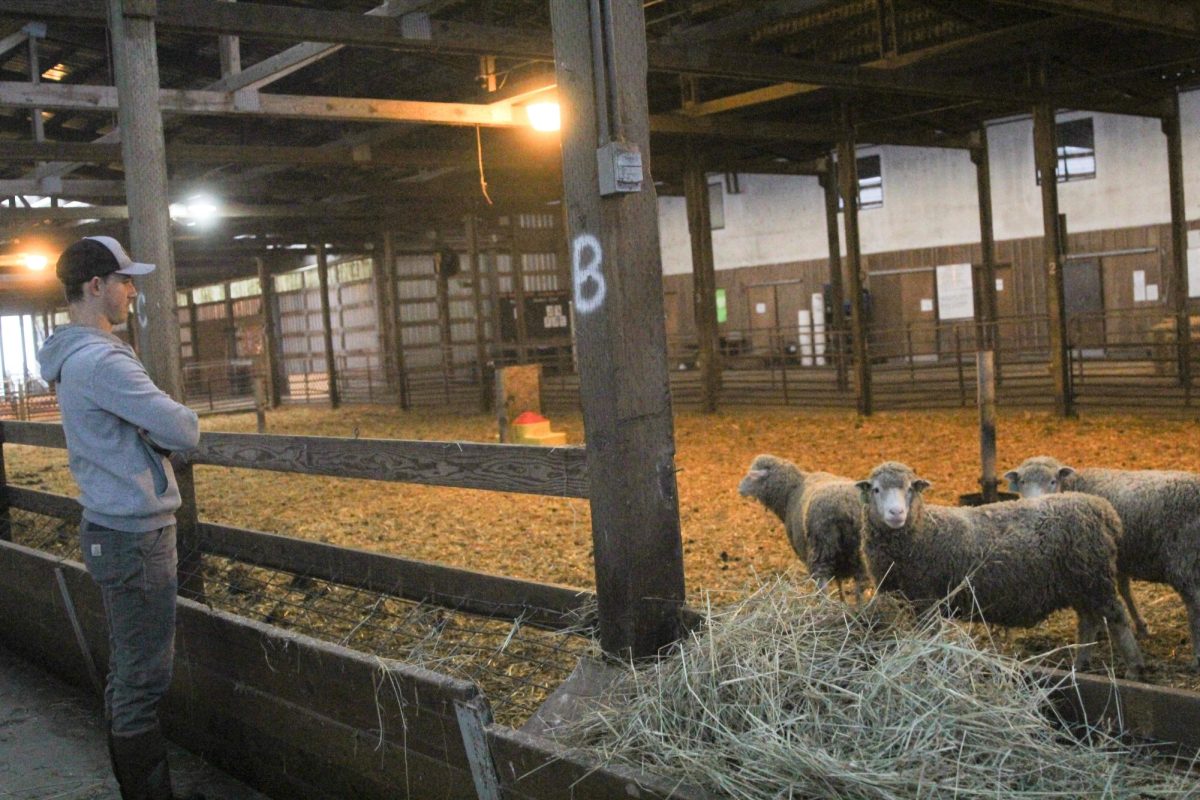
While the spring might hold weaning lambs off of their moms and finishing sheep, the winter lambing season kicks the center’s workload into overdrive.
During the lambing season, which runs from January to early March, more than 75 undergraduate volunteers from across campus help with the additional work, with two students at the center at all hours of the day.
Volunteers, who typically have no prior sheep experience, watch ewes for when they give birth, help clean lambs after they’re born, make sure lambs nurse and move the sheep to individual pens, according to Lear.
Lear expressed that getting students involved in animal agriculture and seeing how production works has been gratifying.
“Seeing this, letting them have the hands-on opportunity, where I can step back and walk them through our process, and seeing them put the puzzle pieces together… That’s the rewarding part for me, not just getting to work with the animals every day, but it’s that student interaction.”
Another OSU agricultural center is the Horse Center.
According to Director Dawn Sherwood, the center boards and takes care of around 20 student-owned horses.
The center is also used for classes related to equine science and is visited by various courses and groups. Sherwood also said that she is organizing a 2026 clinician series, including different horse experts.
“A lot of the students who have their horses out here, this is their lifeline,” Sherwood said. “I think a lot of the students who have boarded here, if this had not been a part of their normal routine, they would have gotten lost and potentially we would have lost them as students.”
While the students who board their horses are responsible for cleaning out their stalls, the center’s six student employees feed the horses twice a day, clean, dump garbage, do maintenance, turn out the horses to pasture and other day-to-day responsibilities.
According to Sherwood, student workers are required to have prior horse experience to ensure safety. She requires two working interviews, where candidates help handle and care for horses and showcase their work ethic.
Maison Otanez, a fifth-year animal science major with an equine concentration, works as one of the two live-in herdsmen at the horse center.
From helping friends with their horses to working at a jumper barn in Montana and a dude ranch in New Mexico, Otanez has always maintained a passion for horses.
As a student herdsman, she oversees other student workers, ensures everything gets done and is on-call for emergencies.
Otanez said that her job entails hard work and that it can sometimes be challenging to live where she works, but she likes her coworkers, Sherwood and the rewarding work.
“Anybody who just wants to do good, hard work is rewarded with it via just the presence of horses or animals. In that sense, it’s a great place to just breathe and work with your hands. It’s a break from the classrooms. It’s a break from people,” Otanez said.
“It’s not necessarily forgiving physically, but it is forgiving mentally… It’s just a good place to be.”
Those interested in learning more or getting involved in the Sheep Research Center, Horse Center or other OSU agricultural facilities can find more information on the College of Agricultural Sciences’ facilities website.