














































































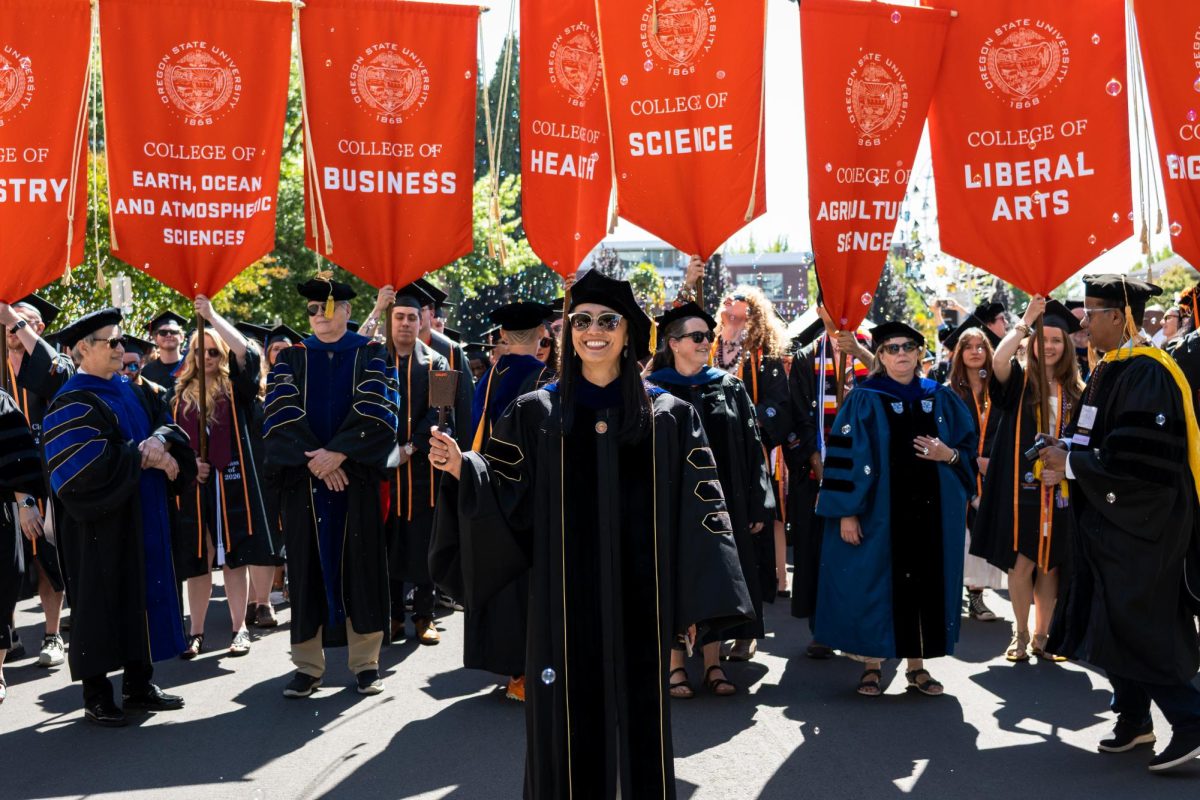



Oregon State University prides itself on being a leader in artificial intelligence education in Oregon, according to its futureai.oregonstate.edu website.
However, some students, including marketing major Victoria Morales, feel the promotion of AI is overwhelming.
“(Professors) use it a lot with presentations, and they encourage us to use it when we’re making business personas,” Morales said. “I’ve just noticed that it’s really prevalent, and sometimes it seems like they use it too much and don’t do enough critical thinking.”
Morales also said they are quick to suggest using AI first, instead of working collaboratively with team members to brainstorm something better.
Morales is not the only person in the College of Business to feel this way. Madysin Alford, a design and innovation management major, has concerns of AI blurring the boundaries of humanity.
“AI should be used for shortcuts instead of taking over design,” Alford said in an email. “I think Art, and design, is a very human thing…to take that away, using AI, it’s like, what’s the point of humans anymore?”
While there are students who share Alford’s sentiments, there are others who see AI as an effective tool.
For instance, Rylee Park, an animal science major, is currently in an animal nutrition class that has an AI “study buddy” integrated into the course.
According to Park, the AI takes information exclusively from the lectures and class material, curating its responses to be specific to the course content.
“I think it’s actually kind of nice,” Park said. “I know that it’ll give me the right answer and not just some random interpretation.”
Molly Robinson, a zoology major, similarly uses the generative AI program ChatGPT as a study tool.
Robinson said in an email that finding practice problems for classes like biology and chemistry has been a challenge, but with the help of AI, she’s been able to better curate her study process.
“That’s the best way for me to learn personally, I use it to create practice problems,” Robinson said.
According to Robinson, AI has also been a cheaper way to study effectively.
“I can’t really afford to pay thirty dollars every time I need a practice test from some tutor,” Robinson said.
Cheng “Chris” Chen, assistant professor of emerging media and technology in OSU’s School of Communication, has been studying the effects of AI integration on students.
In Chen’s class, some students refused to do an assignment in which they were expected to create a K-pop song using the AI music generator, SUNO, citing that their concerns lie in the environmental impacts of AI.
“Overall, perceptions of AI integration are not primarily influenced by how AI is integrated in college learning and whether the instructor discloses AI’s limitations,” Chen said in an email. “It is their pre-existing attitudes toward AI that matter the most.”
As the university looks toward an integrated future with AI, some of its students like Alford find its plans to be questionable.
“I understand AI is going to take over jobs,” Alford said. “But also, this is my education.”