


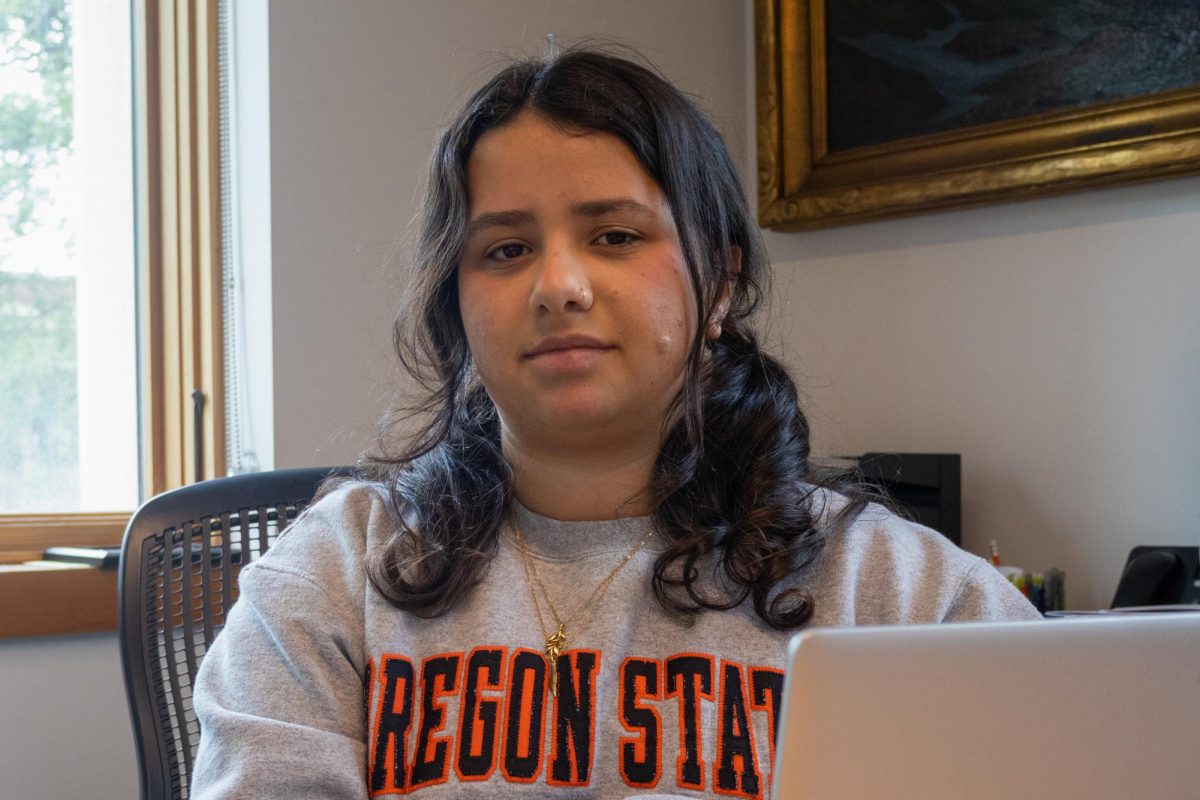




















































































Oregon State researcher Anita Sarma, professor in the School of Electrical Engineering and Computer Science, is stressed about the future of their students and research after federal research funding uncertainty.
In fall 2025, Sarma received a stop-work order, which indefinitely paused a grant from the National Science Foundation that funded her research, which focused on making computer systems more accessible for all learning styles.
According to Sarma, while people’s learning styles vary, not all computer systems and technology match them.
Sarma’s research aims to help product designers gauge the inclusivity of their products toward different learning styles — important for ensuring that all people can stay in technology-related fields and are getting the support they need to learn.
According to Sarma, most of the NSF grant had already been used up by the time she was ordered to stop her work, so her lab was not as heavily impacted as some of her colleagues.
Even so, funding changes have required her to seek other sources of funding. This has impacted research opportunities for students as Sarma has struggled with finding funding for graduate students’ summer pay and has had to eliminate undergraduate research positions.
“Many of my students are international, so not getting them funding is not just that they don’t have food, they can’t even stay in this country anymore. So it is a deep impact,” Sarma said.
Sarma compares running a research lab to running a company — where people need to get paid, students need to be recruited and researchers need to have a continuous flow of work and research to continue securing funding and move up in academia. However, sudden changes in funding have had a large impact.
“Continuity is important, and it’s a lot of pressure on faculty to be able to get (federal research) money,” Sarma said. “‘What’s going to happen to my own research?’ but then there’s the responsibility of what’s going to happen to my students. That’s a lot of emotional anxiety causing stress that a lot more faculty are facing now.”
Oregon State University conducts research across many fields. Much of the money needed to carry out research, including travel expenses, salaries for graduate students and research assistant staff, lab equipment and summer salaries, is funded through federal grants from federal agencies like the NSF and the National Institute of Health.
Since the start of the Trump administration in January 2025, several changes have unsettled the federal funding landscape.
In the fall of 2025, 36 OSU federal grants, worth a combined $14 million, experienced terminations, where already appropriated grant funding is no longer given out.
The Trump administration issued several executive orders freezing, cutting and making other changes to federal funding.
Additionally, funding cuts to agencies like the NIH and NSF were proposed and implemented earlier this year, leading to uncertainty among OSU researchers, some of whom had to pause some of their research operations and let go of staff.
The 43-day government shutdown in fall 2025 led to concerns about the politicization of the science process, which contributed to funding concerns, layoffs and pauses in hiring at federal agencies where OSU researchers share lab spaces and collaborate.
According to an email from OSU Vice President for Research and Innovation Irem Tumer, OSU received $295 million in federal research awards in 2025, a decline of $75 million from the $370 million received in 2024.
Tumer noted that uncertainty about which types of projects might receive funding and how the reimbursement of indirect costs of research — such as facilities and maintenance costs — remain.
Tumer also said that the idea of funding changes in terms of a new federal administration isn’t a new expectation.
“What was different this time (was) the pace and scope of the changes sought by the administration in its first few months, and there’s no doubt that our research and innovation community felt some confusion and frustration as a result,” Tumer said.
However, Tumer notes that research funding is still streaming through.
“While in no way discounting those unsettling feelings, particularly among researchers directly affected by grant terminations, the overall financial and operational impact of federal government actions has been smaller than we might have expected,” Tumer said.
According to Tumer, research expenditures used on research operations totaled $417 million in 2025, $5 million less than the previous year, and grant proposals submitted by researchers remained high.
She said that strengths in technology and energy have allowed OSU to stay competitive when applying for funding.
Tumer also expressed that over the past 14 months, the Division of Research and Innovation has been meeting with OSU principal investigators — the heads of research projects — and has sent communications, hosted town halls aiming to keep researchers informed on executive orders, funded agency policy changes, court rulings and other actions.
OSU has also filed six declarations — or notices of support — for research funding-related lawsuits, including one in support of a suit challenging the federal funding freeze.
For Sarma, while many challenges funding her research remain, she plans to keep pushing through and try to use the situation as an opportunity to innovate.
“It’s difficult to stay optimistic, but I think this too shall pass,” Sarma said. “It’s very uncomfortable now for higher ed, but I think this could serve as a way to break out and do something bigger and better.”