



























































































Oregon State University Professor of Ecology Bill Ripple published a paper with international collaborators in February, synthesizing scientific findings on climate feedback loops and tipping elements.
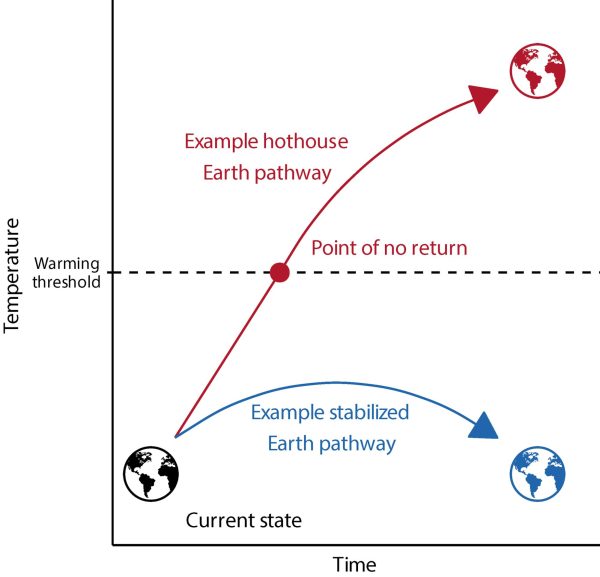
The paper, called “The risk of a hothouse Earth trajectory,” examined how if emissions and climate change remain unchecked, climate feedback loops could take over and trigger additional warming.
Additional warming could lead to a “hothouse Earth” scenario, in which climate change can lead to additional warming at a rate that can no longer be stopped by a reduction in emissions.
Climate feedback loops happen when warming causes changes in the Earth’s system that cause additional warming.
For example, thawing permafrost, or frozen rock and soil, releases carbon dioxide and methane into the atmosphere, which then leads to more warming. Other examples of feedback loops include melting ice and snow, arctic ice melting, forest diebacks, and loss of carbon from soil, which result in more greenhouse gases being released into the atmosphere.
The paper examines 16 tipping elements — systems that could lose stability if certain temperatures of warming are surpassed and feedback loops spiral out of control.
These include the collapse of the Greenland ice sheets and others, the collapse of boreal permafrost — northern forests which remain frozen year-round — and the death of low-latitude coral reefs.
According to the paper, the impact of reaching a tipping point could be compounding and could trigger “a cascade effect,” pushing other systems to their own tipping points.
Ripple is an Oregon State University distinguished professor of ecology.
If enough systems are strengthened, warming could spur additional warming to a point where reductions in emissions no longer stop the feedback loops — or a hothouse Earth trajectory.
“The climate system could begin amplifying warming through its own processes rather than just through human emissions,” said Ripple in an emailed response. “That could lead to much higher long-term temperatures and widespread disruptions to ecosystems, agriculture, and water supplies.”
Currently, there is uncertainty about when and at what temperatures tipping points might be met. Some models suggest that surpassing the tipping point temperature could increase risks of a hothouse Earth trajectory up to 72%.
The paper noted that “uncertainty about where tipping thresholds lie is therefore not a reason for delay, but a compelling reason for immediate precautionary action.”
Ripple’s early research focused on how predators like wolves influence ecosystems through their role in the food chain, including the impact of reintroducing gray wolves to the Yellowstone National Park ecosystem.
Ripple’s research interests have expanded to include climate change. He has also been the director of the Alliance of World Scientists, an organization with thousands of member scientists who aim to communicate the urgency of environmental challenges to a broad audience.
“Over time it became clear to me that climate change is becoming one of the most powerful forces reshaping ecosystems and lives around the world,” Ripple said. “That realization pushed me to expand my research to focus on global environmental change and the risks facing the Earth system.”
“I believe scientists have a responsibility not only to do research but also to explain clearly what the science means for society. Science-based advocacy is really about sharing evidence so that people and policymakers can make informed decisions,” he said.
He noted that phasing out the use of fossil fuels, transitioning towards renewable energy and taking other action will be needed to reduce climate emissions.
While Ripple noted that political inertia, economic interests in fossil fuels and challenges to organizing climate action have made it challenging to reduce emissions, he remains hopeful.
“I am cautiously optimistic. History shows that societies can mobilize quickly when the risks are clear and leadership is present,” Ripple said.
“The climate crisis is not just a technical or energy problem. It also reflects how we see our relationship with the natural world. Humans are deeply embedded in a web of life with many interconnections, and recognizing that reality may require not only external policy changes but also some inner changes in how we value and care for the Earth.”