

























































































Editor’s note: Belinda Batten’s name was spelled incorrectly and has since been updated. The Barometer regrets this error.
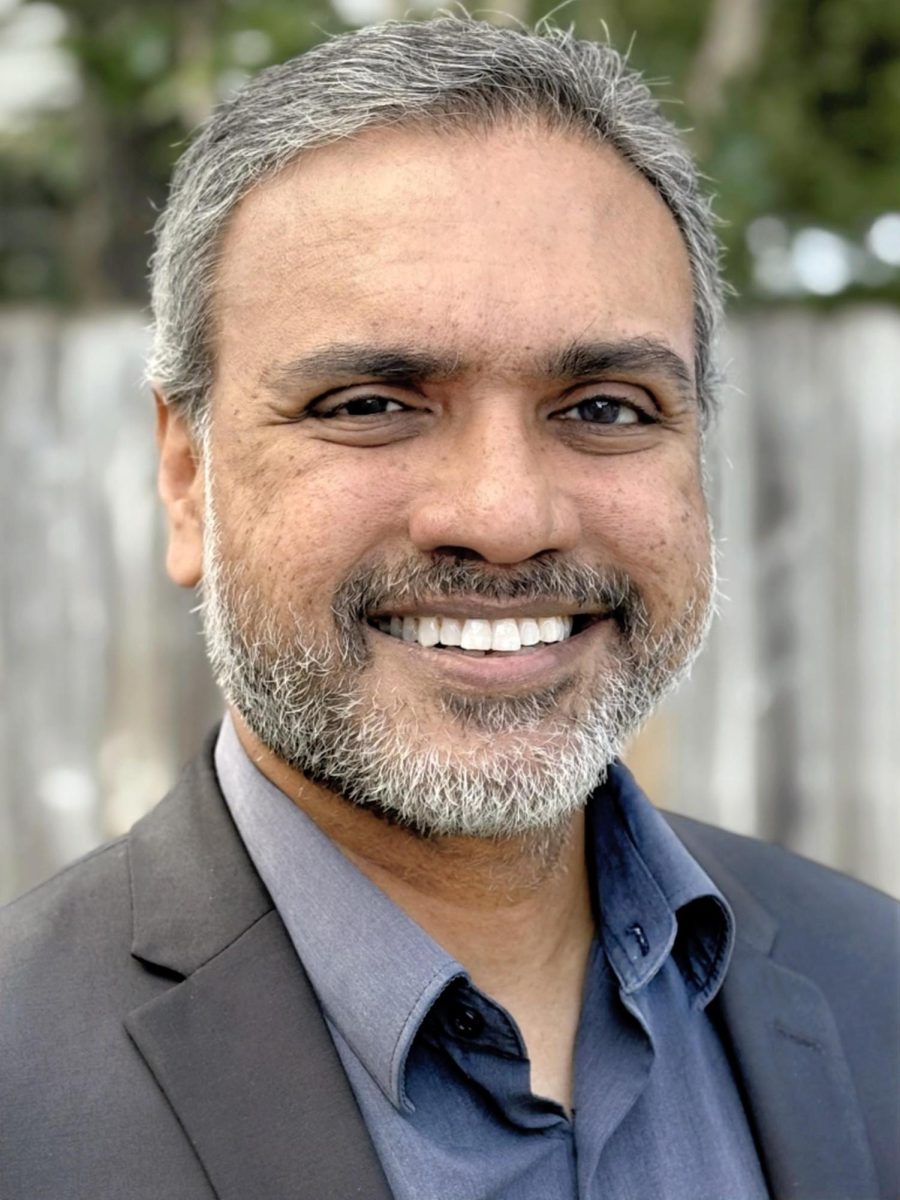
Provost Roy Haggerty announced the hiring of Ruben Rathnasingham as executive director of the Jen-Hsun Huang and Lori Mills Huang Collaborative Innovation Complex in a statement on April 2.
Rathnasingham will start his tenure on May 18, overseeing the $200 million Huang Complex, which is set to open in December.
In his previous job as associate dean for health product innovation at the University of Texas, Rathnasingham worked to develop ideas and technologies from the research stage all the way to start up companies.
Before that, he held a similar research development position at the University of California – San Francisco and in the private sector for healthcare.
Rathnasingham said the first thing that interested him in the position of executive director of the complex was the word “collaborative” in the title.
“We have permission to reach out to very diverse sorts of people, not only within the university, but in the community and in industry, in foundations –to pull people together– to make sure that whatever we’re building will ultimately be useful, will be adopted and will be trusted,” Rathnasingham said.
Rathnasingham said that he hopes students from all majors come to explore the Huang Complex’s offerings.
“I think the first role would be to create this trusted convening space and make sure students feel like they have access to it,” Rathnasingham said.
The 143,000 square foot complex will include an NVIDIA supercomputer, extended reality theater, robotics labs and testing space, and a clean water research lab.
There will also be office space and labs for faculty and space for leasing to partner companies or other universities.
Rathnasingham said that he would like to make the complex a space where students are able to connect in person with professors or industry partners to discuss research projects.
“(Students) care about their careers and the impact they will potentially make, but they also need some guidance around how to go about stepping into those opportunities,” Rathnasingham said.
Rathnasingham noted that these opportunities could include networking with industry partners or getting involved with research labs within the complex.
According to the complex’s website, the primary intent of the building is to provide a space for transdisciplinary research to address issues such as climate science, clean energy and water resources.
“What we’re hoping to come out of the Huang Complex is bringing collaborative teams together, looking at very complex problems that require different disciplines and driving to solutions,” said Belinda Batten, acting executive director of the Huang Complex and senior advisor to the provost.
Rathnasingham also recognized that some students are hesitant about using artificial intelligence because of personal or environmental reasons, but he said he wants to make the space a place to “explore” AI and supercomputing, even if students feel like they have “nothing to do with AI.”
He said he considers the current energy usage of supercomputers and data centers as “unsustainable.”
Rathnasingham said he hopes the complex can be used as a tool for OSU researchers to work on the energy issues of AI.
“Oregon State could be the place, the nexus, where we look at how we could efficiently incorporate renewable energy to run an AI supercomputer,” Rathnasingham said.
Rathnasingham said he considers the success of technology in general to be, in part, determined by its use and adoption by society.
“It has to do with the design, it has to do with how we communicate the value of the technology, it has to do with involving community members up front, as the idea is being generated to help shape the idea into something the community actually wants,” Rathnasingham said.