



































































































In 1986, 19-year-old Jeanne Clery was a first-year at Lehigh University when she was raped and murdered in her dormitory.
Following her tragic death, Clery’s parents “lobbied for revolutionary policy changes that would eventually take form as the Jeanne Clery Act,” according to the Clery Center.
Under The Clery Act, colleges and universities that receive federal funding are required to publish, distribute and disseminate an annual security report. The law is aimed at providing transparency around campus crime policy and statistics.
On Oct. 1, Oregon State University, along with colleges across the country released their Annual Security Report in compliance with the act.
Oregon’s three largest universities — OSU, the University of Oregon and Portland State University — are commonly compared across areas like athletics, enrollment and research funding, yet their campus safety data offers another dimension to consider.
The crimes that must be reported as part of The Clery Act includes offenses such as murder, rape, robbery, aggravated assault, motor vehicle theft, stalking, domestic violence and more.
It is worth noting that while all three universities’ reports include the same crimes, OSU, UO and PSU vary in size, location and reporting practices, thus direct comparisons should be interpreted cautiously.
Each report provides a flat number of crimes but does not take into account the campus population.
To create a more accurate comparison of the data, the crime rates were calculated based on on-campus enrollment numbers of each university. While normalized rates can help illustrate general patterns, they do not create a definitive safety ranking.
Violent Crimes
Violent crimes include rape, fondling, robbery and aggravated assault.
The Clery Act defines rape as “penetration, no matter how slight, of the vagina or anus with any body part or object, or oral penetration by a sex organ of another person, without the consent of a victim.”
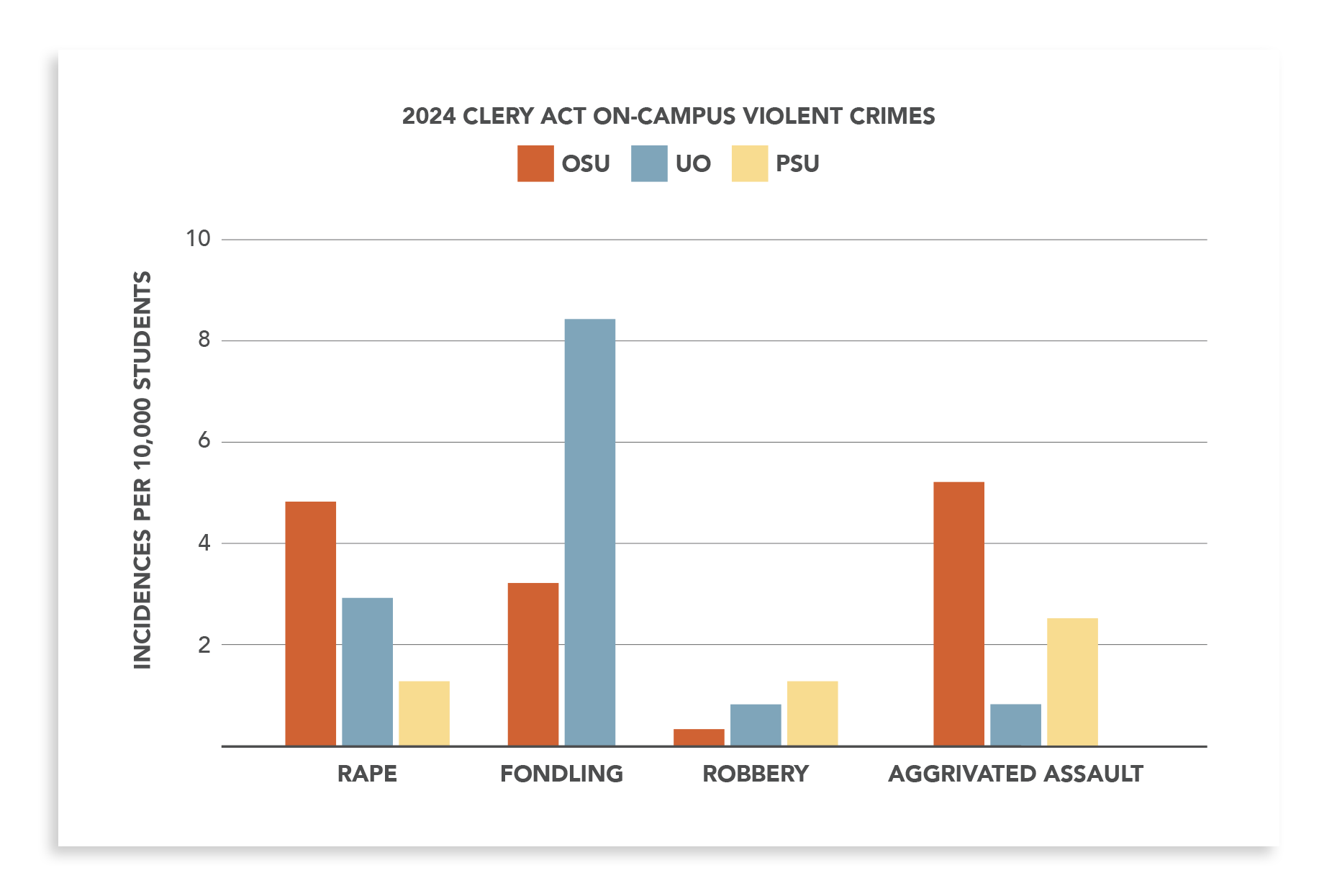
According to each school’s security report, there were 12 rapes on the OSU campus in 2024, seven at UO and two at PSU. Even when student population was taken into account, OSU still had the highest number of rapes last year per 10,000 students.
Another area where OSU led was aggravated assault, with 5.22 incidences per 10,000 students. In 2024, UO only had 0.84 aggravated assaults per 10,000 students and PSU had 2.52.
The Clery Act defines aggravated assault as an unlawful attack on a person with the intent to cause “great bodily harm.”
UO had far higher incidences of fondling than OSU and PSU, however, an asterisk in UO’s report showed that several of the fondlings in 2024 came from the same report, with two reports accounting for seven of the instances of fondling.
Fondling is defined by The Clery Act the touching of the private body parts of another person for sexual gratification without the consent of the victim.
Robbery was similar across all three campuses, but PSU had the highest rate and OSU the lowest.
The act defines robbery as taking or attempting to take anything of value from a person through force or by putting them in fear.
Property Crimes
Property crimes include arson, burglary and motor vehicle theft.
At all three universities, property crimes made up a large portion of the crimes reported, particularly motor vehicle theft.
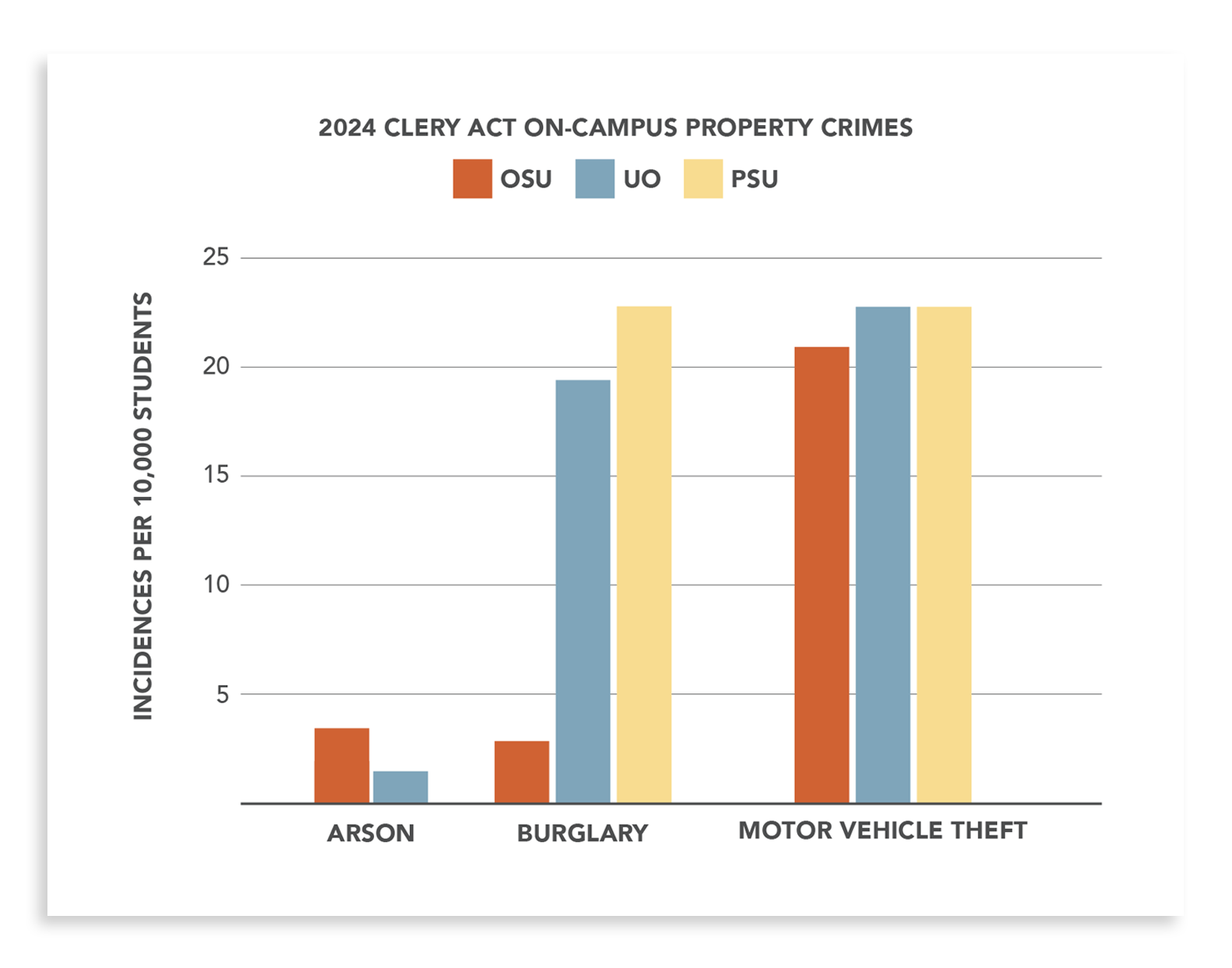
Motor vehicle theft in 2024 occurred at similar rates between OSU, UO and PSU.
Burglary however, occurred at a far higher rate at PSU and UO than at OSU. At OSU, only 2.81 on-campus burglaries occurred per 10,000 students compared to 19.3 at UO and 22.66 at PSU.
Burglary is defined by the act as the unlawful entry of a structure to commit a felony or theft.
There were no incidents of arson at PSU, and a total of five cases reported at OSU and two at UO.
Arson is defined by the act as “any willful or malicious burning or attempt to burn” property.
VAWA Crimes
The Clery Act includes the Violence Against Women Act of 1994’s requirements for reporting to ensure that universities address incidences of stalking, domestic violence and dating violence.
In 2024, OSU saw 11 total incidences of domestic violence compared to zero at UO and three at PSU.
Domestic violence is defined as violent or aggressive behavior within the home, typically involving abuse of a spouse or partner.
Dating violence was fairly low across campuses, with UO having slightly more incidents per capita.
Dating violence is committed by “a person who is or has been in a social relationship of a romantic or intimate nature with the victim.”
Stalking is defined by the act as “engaging in a course of conduct directed as a specific person that would cause a reasonable person to fear for the person’s safety or the safety of others, or suffer substantial emotional distress.”
Stalking made up the majority of VAWA crimes at all three schools, with OSU having the highest rate.
In 2024, there were 12.05 stalkings per 10,000 students at OSU, 9.65 at UO and 5.04 at PSU.