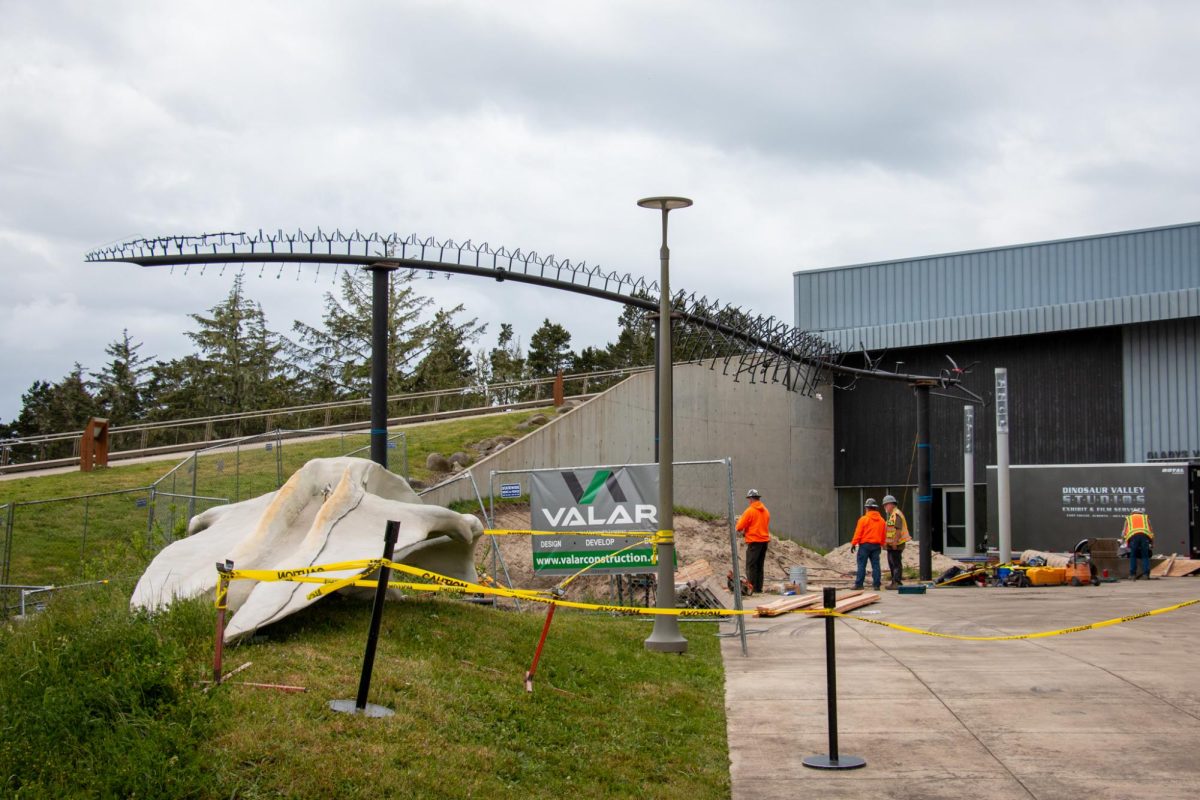































































































Oregon State University’s Extended Reality Theater is set to open in spring 2026 and will be housed within the Jen-Hsun and Lori Mills Huang Collaborative Innovation Complex.
This addition to the complex is done in part due to collaboration by the university with several Oregon technology companies to co-develop their products.
One of those companies, OptiTrack, has close ties with OSU.
Only 3.5 miles south of OSU’s campus sits OptiTrack headquarters. A 50 thousand square foot facility where manufacturing of motion capture cameras is done on site.
According to Marc Alley, director of operations at OptiTrack and an alumnus of OSU’s mechanical engineering program, around 20% of employees were also Beavers.
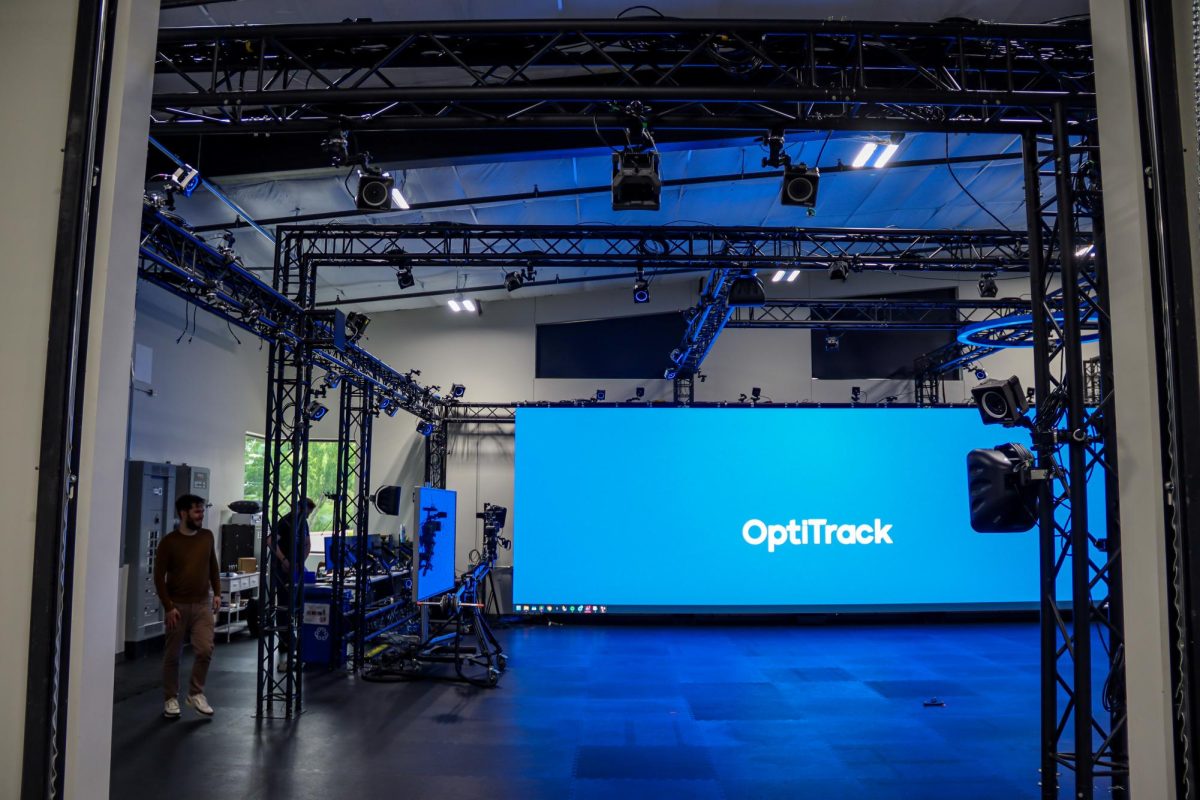
As part of the partnership with OSU, the Extended Reality Theater will have a motion capture volume of roughly 30 by 40 feet in area and 40 feet in height. In addition, Planar, OptiTrack’s parent company, plans to provide a 16-foot-tall and 32-foot-wide LED wall for the space.
Some of the key requirements for the space include that camera units are portable and can be used as part of a campus-wide 3D scanning project, according to Tom Armbruster, OptiTrack’s senior director of sales.
Despite Opitrack now specializing in motion capture technology, it wasn’t always like that.
Initially, the company was founded as Eye Control Technologies, Inc. in 1997, as a follow-up to the shared project of two of OptiTrack’s founders and Corvallis residents, Jim Richardson and Birch Zimmer.
They initially created an eye-tracking device to help Richardson’s cousin, who was paralyzed in an accident and could only communicate by moving his eyes, to find an affordable device to operate a computer cursor.
According to Alley, after learning that tracking head movement was easier than eye movement, a head tracking product called SmartNAV was created by the company that allowed head tracking using a single marker.
Eventually, a third device called TrackIR was developed that could track head movement in three dimensions. Consequently, the device gained traction in online gaming.
“You could actually watch the computer screen and then get head movements and put yourself in a game basically; it was like hat control for the old joysticks,” Alley said.
From that point on, and after several rebrands, the company moved into tracking full-body motion.
Motion capture technology that OptiTrack produces has a wide range of applications from the video game industry to virtual production, animation and defense, according to Andrei Miclea, marketing manager at OptiTrack.
The way motion capture cameras work is by directing infrared light towards retroreflective markers, which the camera then senses. When multiple are set up, the data can be used to triangulate position with up to 50 micron accuracy, or the width of a human hair, according to Miclea.
According to Tiffany Popov, OptiTrack’s quality engineer manager, to capture human motion, participants wear suits that have small gray dots located at approximated bone lengths and joints that allow the computer to identify points on the body. Then users can calibrate the model and build out custom digital skeletons.
“We’ve already done as close as we can of a measurement of my certain bone lengths and joints with the markers themselves,” Popov said in reference to her own experience with the motion capture technology. “But then when we ran through the refinement, it collects samples to better correct for those things.”
One of the fields that OptiTrack is working to move into is more efficient tracking without retroreflective markers. While this can already be done, the process as of now has some downsides.
“You’ll have graphical processing units (GPUs) basically processing video data to recreate the skeleton without having specific points. It’s very computer intensive, it has a lot of problems, and it can’t do a lot of things at once,” Miclea said.
The extended reality theater will include both marker tracking and markerless tracking and will be a very “multifunctional space,” according to Armbruster.
“This is kind of the jumping-off point for what we hope will be a really, really fabulous co-development arrangement and partnership,” Armbruster said.