


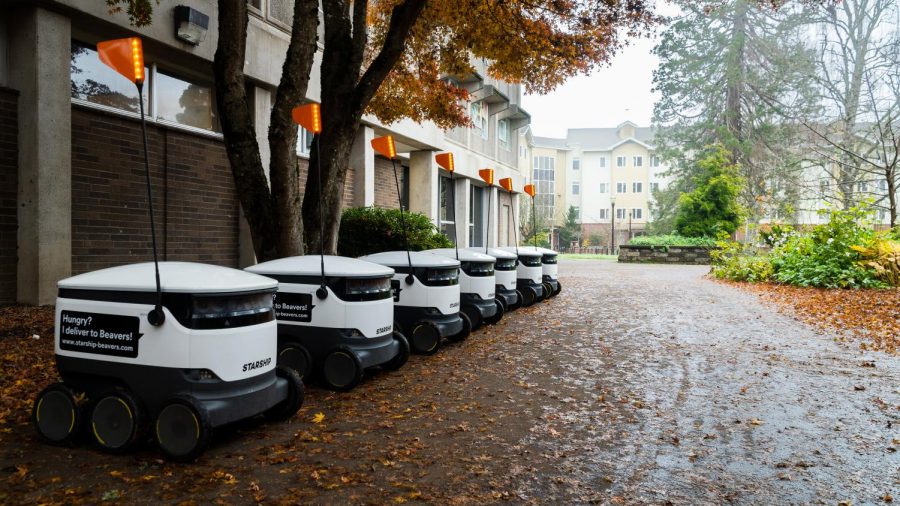


















































































Starship food delivery robots will officially take-off from Oregon State University’s campus on Thursday.
According to a press release found on Starship’s website, this change is part of Starship Technologies’ initiative of shutting down operations across university campuses and transitioning to grocery and hot food delivery in American and European cities.
According to an emailed response from Director of Campus Dining and Catering for University Housing and Dining Service, Kerry Paterson, UHDS does not currently have any plans for food delivery alternatives over the summer.
“We’re actively investigating various options related to what the next steps may be for food delivery and pickup via an online ordering process moving forward,” Paterson wrote in the email.
The company was founded in Estonia in 2014 by Skype co-founder and developer, Janus Friius and Ahti Heinla respectively. Since then it has expanded to over 60 college campuses globally, along with some urban areas.
As part of the growth plan, Starship plans to redeploy over 1,200 of its previously on-campus robots to grocery store locations across the United States and Europe.
“We know how valued this service has been on campus and ask for your patience as we actively explore other avenues for convenient pickup and delivery moving forward,” said University Housing and Dining Services in a statement on their website.
The autonomous delivery robots were first introduced to campus in October, 2020 and played a part in delivering meals from dining halls to students in the dorms during the COVID-19 pandemic.
The six wheeled robots used machine learning and sensors to roam sidewalks and cover nearly 500 acres of campus and could even sing to customers when completing a delivery.
Initially, the fleet numbered around 20 robots, but soon expanded to 80 by 2022, as the robots continued to fill delivery demands.
During their time at OSU, Starship robots prompted mixed feelings from adoration to annoyance, traffic concerns and even worries over an impending robot revolution.
William Gillette, a third-year kinesiology and music major, never used a starship, but had several experiences with them last year, falling down the stairs of West Hall, usually between 10 p.m. and 4 a.m.
“I was the first floor RA, so naturally it would fall on my responsibility to wake up, sprint outside…because they would scream their little robot heads off that they fell down the stairs onto the sides or their back,” Gillette said.
Then Gillette and his residents would flip them over to safety.
Gillette said that he would not miss them on campus.
“I have no need to use a starship, I can perfectly walk anywhere,” Gillette said.
Siva Brathapan, a first-year electrical and computer engineering major, used Starships somewhat frequently and said that he would be sad when they leave.
“I feel like (the Starships) kind of symbolize that engineering is the strongest major at our school,” Brathapan said. “I feel like getting rid of that is like getting rid of a symbol.”
Eron Louma, a first-year mechanical engineering major, said he had never used the delivery robots and was “indifferent” to them leaving, but would miss helping them when they were stuck.
“(The Starships) would be like ‘Thank You,’” Louma said. “I felt like that was kind of fun.”
Both Louma and Brathapan said they had witnessed vandalism of robots.
For instance, Brathapan noted a time in which he witnessed a man tipping over several of the delivery robots at once and running off.
Louma added his own accounts of seeing vandalized Starships.
“The flag was split in half, and there were wires hanging out of the top…” Louma said regarding the state of the vandalized robot. “Someone obviously tormented this.”