
















































For many of the more than 300,000 graduates from Oregon State University since 1870, getting to graduation required overcoming challenges and making their mark on the university.
As OSU’s class of 2026 gears up to graduate, The Barometer takes a look back at four students from the past who broke barriers and made history by studying at OSU.
Alice E. Biddle

One of the first three graduates of OSU, at the time known as Corvallis College, Alice E. Biddle was the first female to graduate from OSU in a class with two men in 1870.
Born in 1854, Alice’s parents operated a drug store and her father served as mayor of Corvallis.
In addition to being the first female alumnae of OSU, Biddle was also the first woman to be granted a degree by a state college in the western United States.
Biddle completed her Bachelor of Science degree at 16 years old after three years of study. She married college professor William Walter Moreland, the namesake of Moreland Hall.
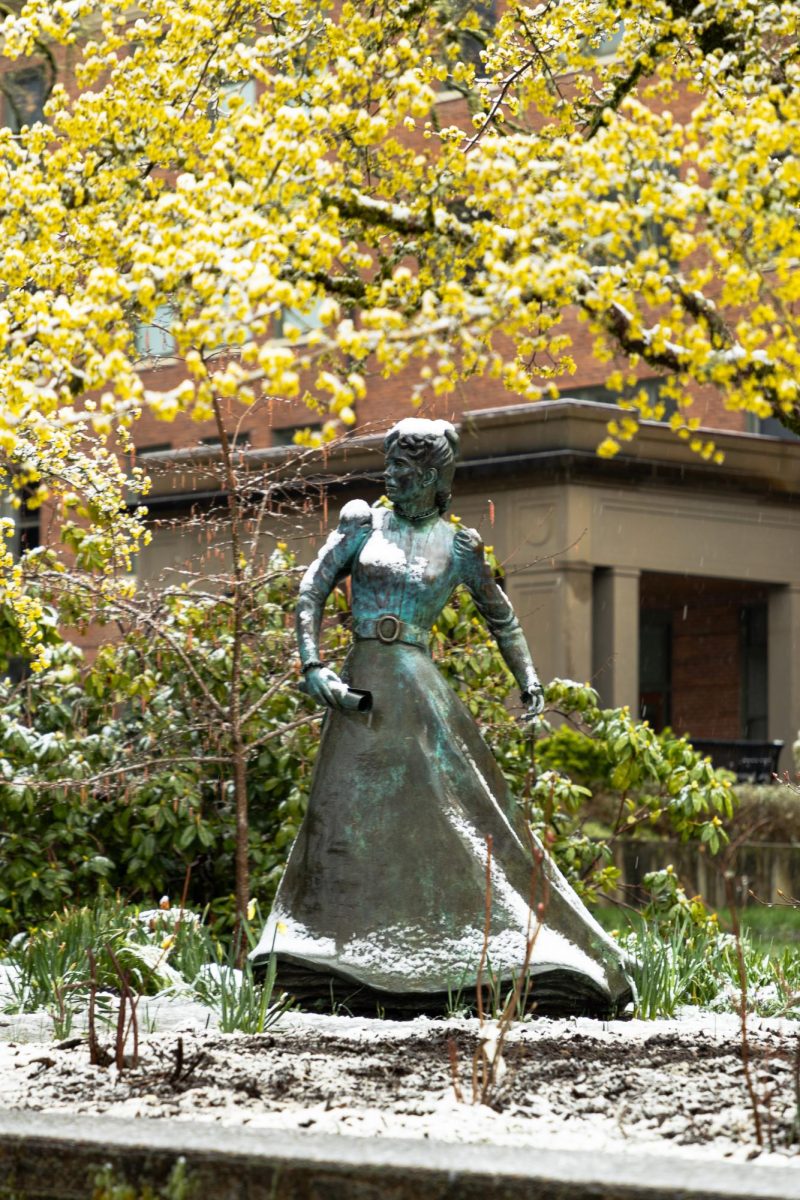
A sculpture of Biddle is located on the southwest corner of Strand Agricultural Hall by the Student Experience Plaza.
Carrie Halsell

Carrie Halsell broke barriers by becoming OSU’s first black graduate after earning a B.S. in commerce in 1926.
Halsell was born in Boulder, Colo., in 1903. In 1912, Halsell and her family moved to Salem, Ore., where she was the first African-American person to graduate from Salem High School in 1921.
In 1922, Halsell enrolled at OSU, then known as Oregon Agricultural College. At the time, black students were barred from living on campus.
After graduation, Halsell moved to the East Coast, where she went on to work in various roles in higher education. She served as an assistant to the registrar and instructor of Business Education at Virginia State University and as a faculty member in business administration at South Carolina State University, where she worked until her retirement in 1968.
At both VSU and SCSU, she worked with African American sororities. Halsell also continued her studies and earned a master’s degree in business education from New York University in 1945.
In 2002, OSU named a residence hall, Halsell Hall, in her honor.
Chung Kwai Lui

Chung Kwai Lui was a key part of the United States’ atomic weapon development program during World War II. Before then, she was the first woman to receive a doctoral degree from OSU, graduating with a Ph.D in physics in 1941.
Lui was born in Canton, China, in 1909. In 1929, she enrolled at Lingnan University, where she graduated with a degree in physics in 1933. After graduation, Lui taught physics at a middle-school level while taking graduate physics courses at Lingnan.
In 1936, Lui moved to the United States, where she was offered an exchange scholarship that covered her tuition and room.
After a year of study, Lui completed her master’s degree under Professor Willibald Weniger, the namesake of Weniger Hall. She went on to complete a Ph.D. in physics in 1941.
After teaching physics as an instructor at OSU for several years, Lui got hired by the Westinghouse Lamp Research Laboratory in New Jersey, where she studied materials used in fluorescent lamps.
The Manhattan Project, a secret U.S. project focused on developing atomic weapons during World War Two, used Lui’s expertise in uranium, which was being studied by Westinghouse for potential use in lamps, for researching how to purify the substance for use in atomic weaponry.
Lui’s student visa meant she would have to return to China to apply for permanent residency in the U.S., but concerns that her Manhattan Project knowledge would be taken by the Chinese Communist Party led Congress to pass and President Harry Truman to sign a bill so she could stay in the country.
Lui was also named as a “Woman of the Day” by First Lady Eleanor Roosevelt in 1949.
Lui continued working at Westinghouse until her retirement in 1974. Throughout her career, Lui published many papers and was awarded two patents.
William “Bill” Tebeau

William “Bill” Tebeau was the first African American male to graduate from OSU, then known as Oregon State College. Tebeau was born in Baker City, Oregon, in 1925.
Tebeau enrolled at the OSC to study Chemical Engineering in 1944. After being refused a dorm room because of his skin color, he found a place to live in the basement of a nearby house in exchange for tending the furnace.
During college, Tebeau was involved in the Alpha Phi Omega fraternity and the Pi Mu Epsilon math organization.
Tebeau was also a musician, playing both the trumpet and the violin. He played in the marching band and in the KOAC radio station’s studio band.
After graduating from OSC in 1948, Tebeau earned his civil engineering licence and worked for the Oregon Department of Transportation. He worked at ODOT for 36 years, where he provided expertise in construction, city planning, and other areas.
His work earned him the State of Oregon’s Employee of the Year award in 1971.
Tebeau was also an educator and taught part-time at Chemeketa Community College in Salem, Oregon, as an engineering professor. He taught a variety of classes, ranging from economics to thermodynamics, and was named teacher of the year at Chemeketa Community College in 1970.
Described by his family and friends as humble, kind and a role model to many, Tebeau’s daily motto was said to be “Make it a great day!”
Tebeau died in 2013 at the age of 87. A residence hall, Tebeau Hall, was dedicated in Tebeau’s honor in 2014. Oregon State Highway 126, which goes between Florence and Eugene, was also designated as “William Tebeau Memorial Highway” in 2016.
