
















































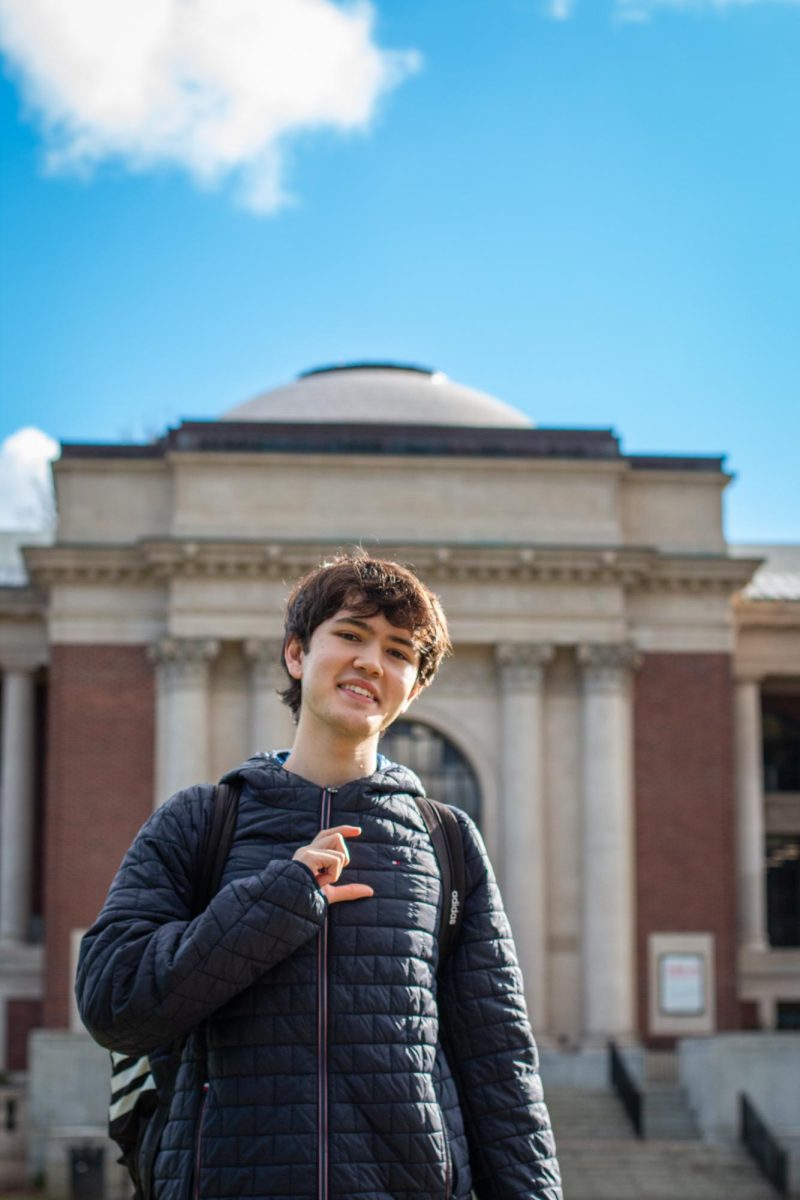










For many fourth-years, such as Artificial Intelligence Club President and computer science major Marat Muzaffarov, AI being a new addition to the entry-level job market has reshaped their post-grad preparations.
“Everyone needs something, some sort of project in college to prove that once they graduate, they’re worthy to hire with (a) computer science (major). It was just ‘Go get your degree and you’d be fine,’ and that was normal, but it’s not. You need to do more to be able to get internships and jobs, especially right now when the field is so oversaturated,” Muzaffarov said.
According to a 2025 Forbes analysis, up to 50-60% of jobs could likely be automated or significantly transformed by 2040, with potential for 80% or more by 2050 if AI innovation continues steadily.
“We need to see AI more as a tool rather than a threat,” said Karla Rockhold, director of Alumni Career Engagement. “A lot of young alumni in computer science have really struggled to find work. Some of them have been out for two years and still haven’t found a job.”
“I think every interview moving forward, the employer’s going to ask: ‘How do you envision utilizing AI in this role?’” Rockhold said.
Fourth-year computer science major Noah Pragin, project manager for the AI club, said, “Nobody out there is just a ‘computer scientist.’ You need to know what you want to build. AI won’t replace you, somebody else with AI will.”
Oregon State University Professor Demian Hommel is part of an AI fellowship sponsored by OSU’s Center for Teaching and Learning and has researched how to use AI to his and his students’ advantage.
“If you’re worried about a potential job or career being taken away by AI, focus on the part of that job that can be benefited, that can be furthered by generative AI,” Hommel said.
He also said that for graduate students, there has to be an expectation that things might not be exactly how you planned them right off the bat. “Expect to have to pivot, expect to have to retrain, to broaden or deepen your skill set, expect things not to work out, and then some will and some won’t.”
Mindie Dieu, an instructor for the College of Business, explained that there are a few skills that AI can not replace as of now, including “those of networking, of human interaction, interpersonal skills, of building bridges and cooperation and teamwork.”
She also suggested that students use ChatGPT or Microsoft Copilot to review their resumes and make them applicant tracking system-friendly.
“Ask for help, we’re here to help you. The career services center and (students) advising team. I mean, there’s a whole thing just available in the College of Business,” Dieu said.
Hommel said, “You want to look for opportunity, you want to be pragmatic. You want to try to find something that’s valuable about what you’re doing or creating or bringing to the world, not just the financial part. That is what a lot of a career is; it is finding value.”