




















































































Editor’s Note: The Daily Barometer has retracted the original version of this story, which ran on Feb. 3, due to factual errors. The Barometer regrets these errors.
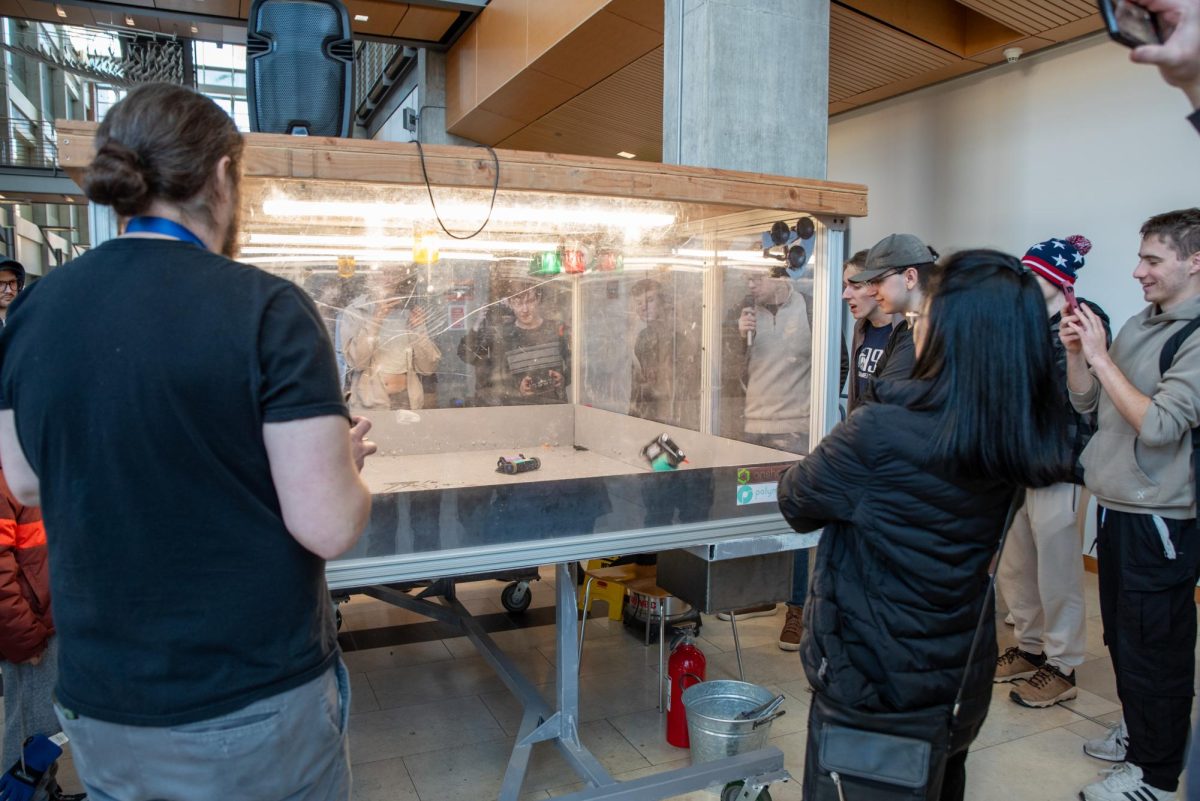
Whirring motors, sparks from spinning metal striking metal, chunks of 3D-printed plastic flying everywhere, ricocheting off of thick polycarbonate.
These were the sights and sounds of the Combat Robotics Team of DAM Robotics Club’s Winter Wars ‘26, which took place on Jan. 24, in the Kelley Engineering Center Atrium.
Sponsored by Repeat Robotics, Polymaker and OnShape, Winter Wars ‘26 featured combat robots facing off in a “double-elimination tournament where winning means incapacitating or destroying the opponent,” according to the event page.
The competitors’ robots went head-to-head in OSCR’s 6-feet-by-6-feet, 3-feet high arena in the middle of the atrium. The arena also featured a 1-foot square hole with a 1-inch lip. If a robot falls into the pit, it has 10 seconds to get out before it loses the match.
The tournament used a double-elimination style bracket system, where the winner of the loser’s bracket for each weight category faced the winner of the winner’s bracket. A loss in the loser’s bracket meant elimination from the tournament.
If one contestant managed to incapacitate their opponent or knock their opponent into the pit, that player would win. However, if time ran out without a clear winner the judges would determine the winner by a point system: up to five points for engagement and controlling the opponent and up to four points for how much damage was done.
Winter Wars is DAMRC’s second of three robot combat events this fiscal year, hosting one for each term.
According to event coordinator Brandan Silvis, DAMRC — formerly known as Oregon State Combat Robots — has put on these events since 2021.
“It’s not just OSU students that compete,” Silvis said. “We have people come from all around the west coast to fight in the tournament.”
Using the newly revised Sparc rules for robotic combat, the event featured four weight categories.
The first, Fairyweight, consisted of robots that can weigh up to 150 grams, around one-third of a pound. These small robots are made mostly from 3D-printed plastic parts designed by the combatants.
The next category was Plastic Antweight. The most popular category at the event by number of robots registered, this category is for plastic robots that can weigh up to one pound. The Plastic Antweight combatants in this year’s competition included OSU alumnus Charlie O’Brien’s Poison Dart Frog, which as of the tournament, was ranked 11th in the world on robotcombatevents.com.
According to Silvis, this category is popular, because if the robot is destroyed, you can just 3D-print a new one.
Silvis, who recently won the award for fastest rapid disassembly at the last CTRL PDX event, was excited about a new rule that says the competitors can’t do anything other than annealing — a heat treatment process — to strengthen the plastic on their robots, which he said will lead to more explosions.
The next category was Full Combat Antweight, which is similar to Plastic Antweight in that the weight limit is one pound, but Full Combat robots can be made of any material.
The final category was also the heaviest. Beetleweight bots can be made of any material and can weigh up to three pounds.
According to the rules, there is no stipulation about how many robots can compete as one unit, so Beetleweight competitor Ribbet Ribbet actually consisted of three one pound robots competing together against one larger opponent.
Showing off his own Plastic Antweight robot Kid Copperhead, Silvis said the combat robotics promotes modularity in design to be able to adapt to different opponents with different components.
“For example, if the opponent is using a straight wedge for their weapon, you would want to use a fork in order to get under it,” Silvis said as he changed out a part of his robot.
Designs ran the gamut from the frisbee-shaped Duncecap equipped with a conical shape in its center to Kid Copperhead, essentially a spinning drum weapon with wheels.
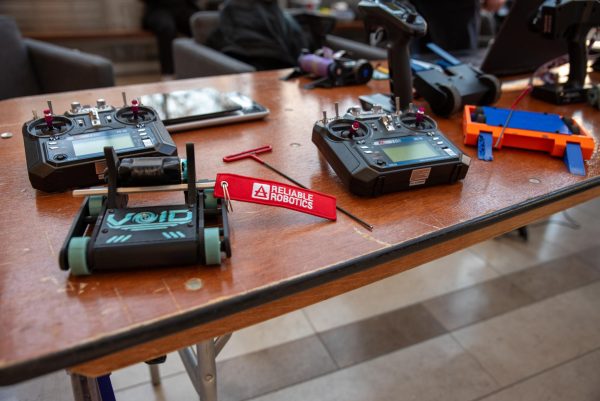
Silvis said he was most excited to see how the newcomer Void would perform at the tournament. Void, designed and driven by the Vice President of DAM Robotics Maxfield Dodge, is a robot with a new type of spinning drum weapon that Silvis said is especially powerful.
According to Dodge, he used generative design on the CAD software Fusion 360 to develop the weapon on Void. The software was able to maximize the power it can generate while minimizing the materials needed for the design.
The Tournament
In the Fairyweight category final, ZipZop defeated Mark 14 by judges’ decision. ZipZop continually flipped and pinned Mark 14 throughout the match, resulting in a clear victory.
Since the majority of the Full Combat Antweight robots ended up fighting together as one Beetleweight competitor, there was no winner for the category.
The Plastic Antweight final ended with Void winning in a brutal upset against Poison Dart Frog. Void’s spinning drum proved too much as it systematically crushed Poison Dart Frog, sending its components (and the robot itself) flying around the arena. The match ended with PDF getting launched into the pit.
In the Beetleweight final, the collective known as Ribbet Ribbet went up against Toad Rage. Looking for every advantage they could get, Ribbet Ribbet mixed and matched robots and parts to get the maximum advantage against its opponent. One of the trio, Ribbet, even had what the announcer could only describe as a “snowplow” affixed to its front, as well as a small blue toy frog wearing a cowboy hat.
However, all that preparation didn’t stop Toad Rage from knocking each part of Ribbet Ribbet into the pit. It was the general consensus of the crowd and the announcer that Ribbet Ribbet did more collateral damage to themselves than they did to their opponent.
According to Silvis, DAMRC’s Next Combat Robotics Tournament — Spring Skirmish — will be sometime during the spring term.
For those that want to know more about combat robotics at OSU, follow the links below: