





































































































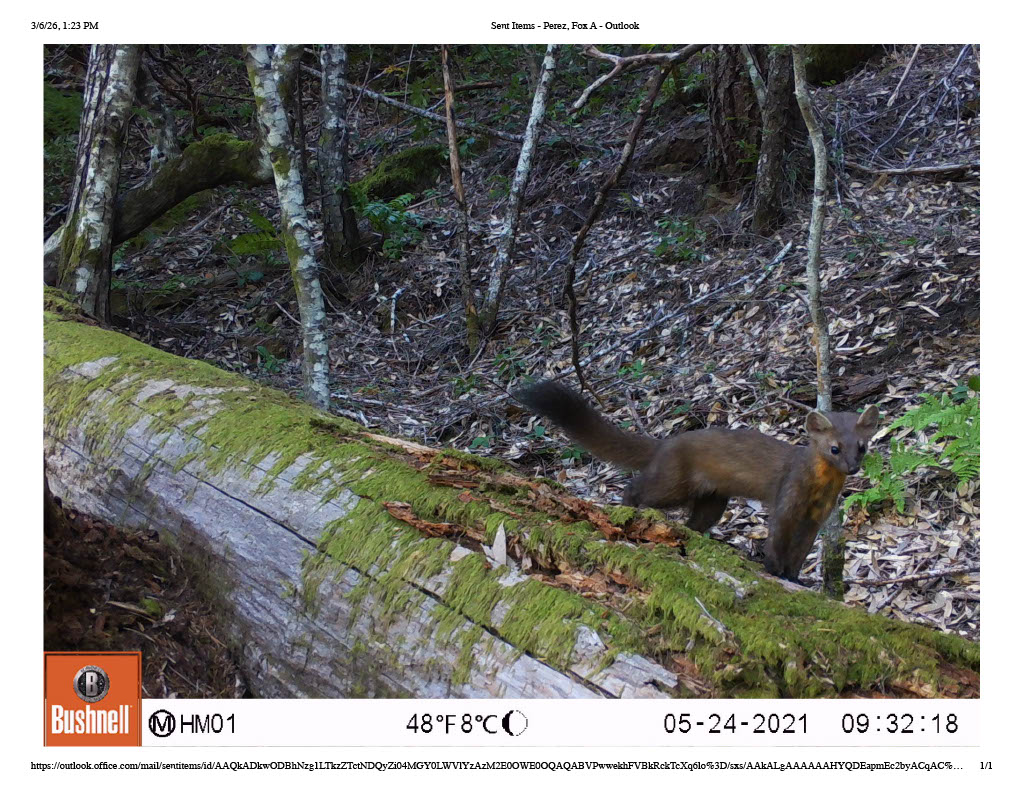
The west coast is full of interesting creatures, but one of these animals was recently categorized as “threatened” under the Federal Endangered Species Act. To conserve the coastal marten population, Oregon State University’s Institute of Natural Resources created the Coastal Marten Project.
Sean Matthews, the conservation biology program manager with the INR, explained that coastal martens are members of the weasel family, who live in older forests and have historically inhabited the coastline from Northern Oregon to Northern California.
Due to the coastal marten population declining, they are now living in smaller, more isolated populations, with one just outside the town of Florence, Oregon and others near the Oregon-California border.
“If we don’t move fast enough … then martens may not be around for very much longer,” Matthews said.
According to Matthews, the main causes of the coastal marten’s population decline are forest fires, fur trapping, logging and predator and pest control. Matthews explained martens will find the poisonous baits intended to kill local livestock predators.
“They weren’t the intended target for these poisons, for these predator control campaigns, but they managed to find poisoned baits,” Matthews said. “And when they find those poison baits, they succumb to the poison and end up dying, often.”
To address these issues, Matthews explained project leaders are working with forest managers to learn which forests the martens are living in, estimate the population of that area and share that information with forest managers.
“And then (we) try to also to find out what types of forests they were living in and share that information with forest managers,” Matthews said.
According to Matthews, the project involved working with multiple partners, such as the California Department of Fish and Wildlife, Cal Poly Humboldt and the University of Wisconsin Madison.
Three more of these partners are land owners — the Yurok tribe, the Six rivers national forest and Green Diamond resource company. The project was also funded by the U.S. Fish and Wildlife Service and the Volgenau Foundation.
Matthews said studying the secretive martens was both the most challenging and rewarding part of the project.
“They’re very secretive and hard to detect, which makes our job a little bit harder trying to estimate the number of martens out there,” Matthews said. “The most rewarding (part) is probably overcoming those hurdles and working with partners to do so.”
According to Matthews, the average individual can help with the conservation of coastal martens by donating to organizations currently doing research and working to conserve martens, as well as being informed consumers.
“Martens depend on older forests and when we are buying things like paper products … making sure they are certified, ideally from the Forest Stewardship Council,” Matthews said.
For more information about the project, visit the INR’s website at inr.oregonstate.edu.