





























































































Miles of tunnels twist and turn under foot of students and faculty. With consistent heavy rainfall and freezing temperatures, how does Oregon State University ensure safety for workers and students?
According to Les Walton, Energy Operations manager for the Energy Center, the first tunnels were constructed in the 1890s as direct barrier pipes for steam distribution, but most of the tunnels were constructed in the 1950s.
Today, their current purpose is to house utilities in easy-to-access areas, with most of the focus being on chilled water, electrical systems and general communications.
A majority of the work Walton and his team conduct involves regular preventative maintenance checks, minor repair work and electrical inspections across 2.5 miles of tunnels.
“There’s no impact from any type of bad weather or power outage,” Walton said. “The Energy Center supplies all of the heating for the campus, is on its own power and is actually a generation plant where we actually produce power to support Corvallis and the OSU campus. So if there’s a power outage, it doesn’t bother us one bit.”
In fact, if there’s an issue with a building on campus and the utilities involved, students wouldn’t be impacted but instead be supported by the tunnels and the work Walton and his team do.
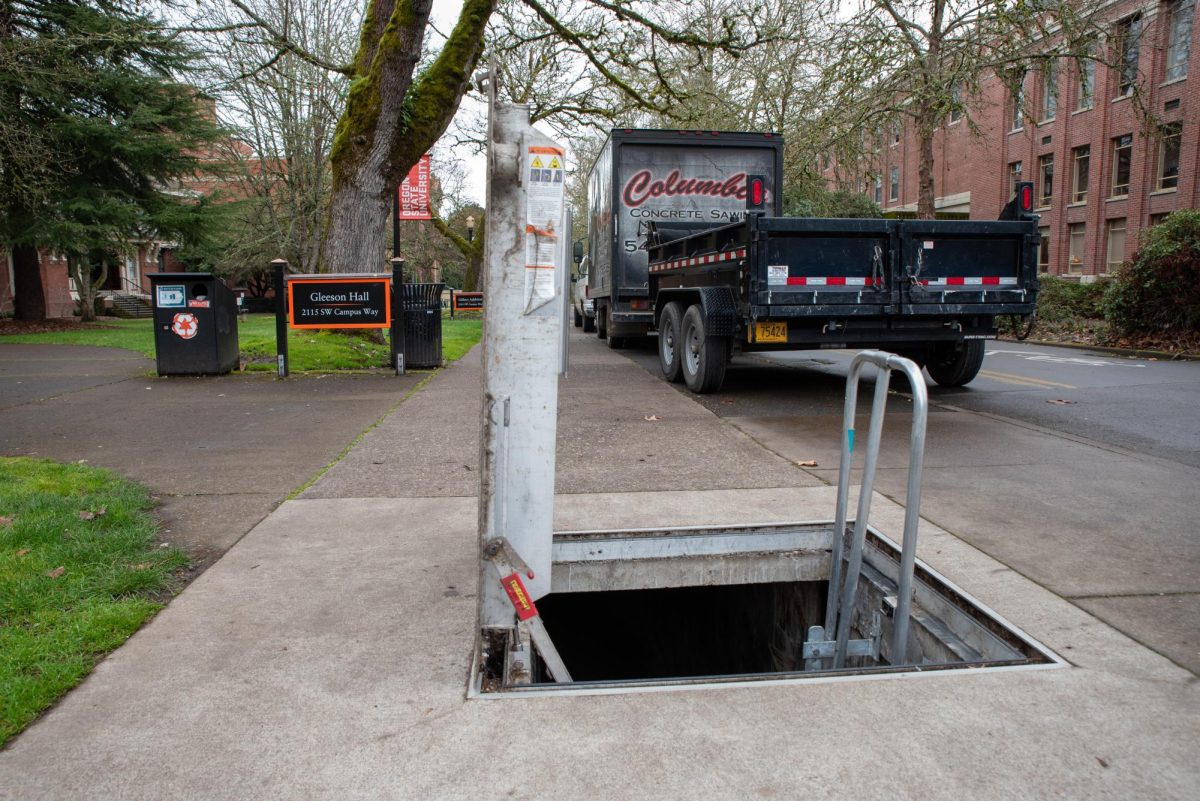
Hall on Campus Way on Feb. 19. (Kenzie Whaley)
“It’s virtually unnoticed by students or anybody that’s above ground,” Walton said.
According to Walton, the exceptions to these rules do come about when buildings such as Austin Hall or Sackett Hall have utilities that can’t be accessed by the tunnels, which can have an impact on students, faculty and staff.
One thing that does impact the tunnels is heavy rain; rainwater gets into the tunnels via hatches or storm drains.
“They don’t get flooded out to where I have to shut the tunnels down completely, but they do get a couple inches of water in them,” Walton said.
Walton and his team do utilize pumps and other water-removal devices to keep water levels in the tunnel manageable enough that he and his team can still walk through them. As one might imagine, the tunnels do often get quite humid, especially after a rainstorm.
“We’ve gone through earthquakes in the past … major flooding in ‘96 and 2008 … the tunnels are very resilient; I mean, they are fully encased in concrete,” Walton said.
Walton does offer tours of the tunnels to students; they can inquire about that via his email [email protected].