






















































































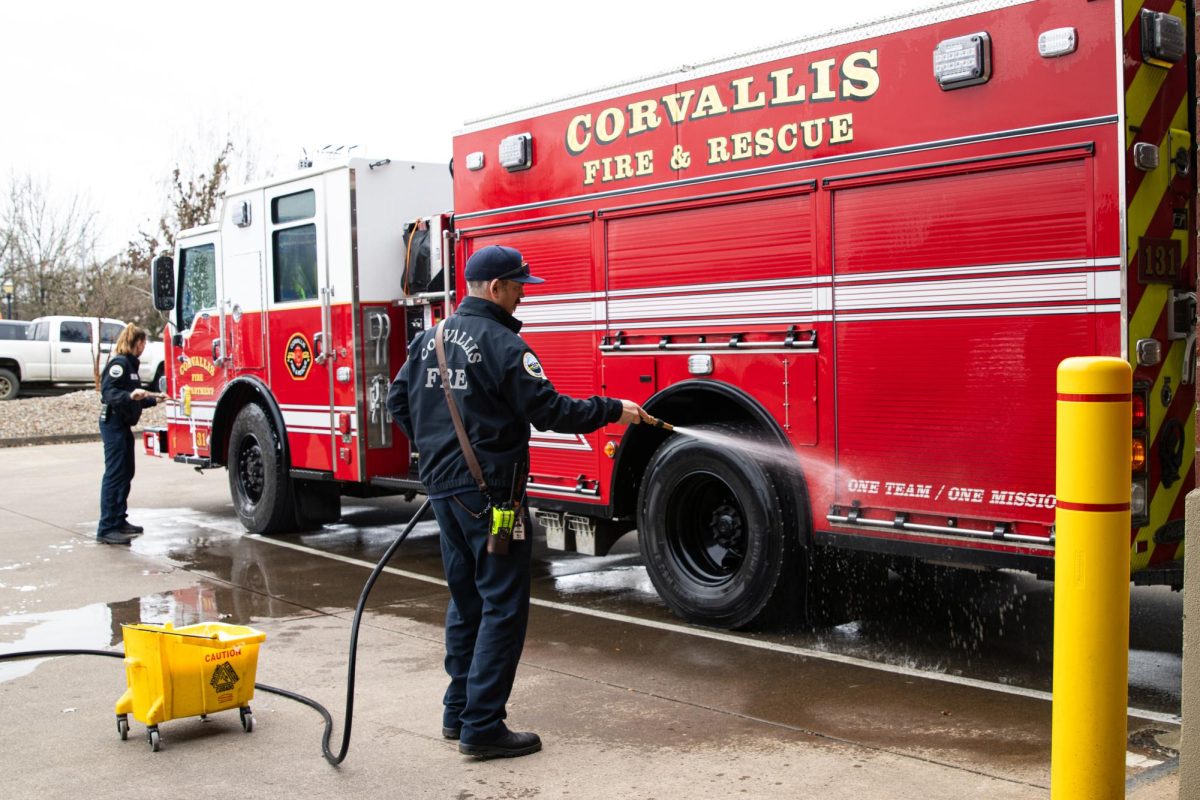
Firefighters from the Corvallis Fire Department came home after spending 14 days in January assisting the Los Angeles metropolitan area in extinguishing their most recent wildfires and assessing the aftermath.
The LA wildfires started on Jan. 7, impacting residents throughout the month until they were officially allowed back into the Palisades area on the morning of Feb. 2 with specific considerations.
Recently, the Los Angeles wildfires have created an instance for an individual such as Corvallis Battalion Chief, Rob Yencopal to put their experiential knowledge to the test, assisted by some of the team members on his strike team and guided by any stipulations placed by local government.
Upon his return, Yencopal used past experiences to guide while bringing back new ones to tell.
Yencopal has worked at the Corvallis Fire Department for over 20 years, initially starting as a volunteer when he was a student attending Oregon State University in the College of Forestry.
Prior to his volunteer work at OSU and his career in Corvallis, Yencopal had been hired by the Forest Service to work primarily on land fires. However, only through volunteer work did his passion for firefighting ignite, and he learned the differences between land fires versus infrastructure fires.
With a precedent created by fluctuations in crime and populations, it became necessary for the Los Angeles communities to outsource individuals equipped to respond to both social and environmental crises.
To address the repopulation of the Palisades area, Los Angeles Mayor Karen Bass wrote in a public announcement, “Our recovery effort is based around getting people back home to rebuild as quickly and as safely as possible. If you do not need to be in the Palisades, don’t be. We have a zero-tolerance policy for crime.”
The wildfires in the Palisades, Eaton and Hughes areas had extensive coverage, so the Los Angeles Police Department increased its deployment to better aid the transition.
In that same announcement, LAPD Chief Jim McDonnell said,
“The presence of LAPD and other law enforcement forces will be more than ten times the deployment before the start of these fires.”
This led to the deployment of teams in other states or regions, including that of the Corvallis Fire Department.
Throughout their exchange, the strike team worked with others beyond the Los Angeles Fire Department including teams from San Diego or San Francisco; additionally, their work expanded to include Southern California holistically in correspondence to fluctuating conditions.
Yencopal detailed the transition between roles as the requirements for fire resistance and community involvement progressed.
“Our initial assignment right in the Palisades was finding hotspots, putting them out and patrolling and making sure that no other fires were started. And then during the middle of our deployment, we got moved to a different area as they were expecting more of the Santa Ana winds to come in,” Yencopal said.
For these particular wildfires, the firefighters from the Corvallis strike team partnered up with those from San Francisco to better locate fire hotspots while assisting those repopulating areas where the fires had been contained.
Amidst recounting the interactions he had with both those he worked with and those whom he assisted during the rehabilitation, Yencopal discussed what he felt to be a profound aspect of human nature underscored by the fire.
Yencopal vividly describes the instances in which families had to face the realization that they lacked the homes they woke up in every day, and how despite that, he would see endless perseverance.
“When you have something as catastrophic as that, it really does shake people down to their core and opens eyes to their inner heart and care for other human beings, and it doesn’t matter who, right?” Yencopal said. “At that point in time, they don’t care about, you know, who you voted for, what you look like — it’s ‘You’re a person, we’re in this battle together, and I care for you.’”
The most frequent sentiments expressed by returning residents, according to the Corvallis firefighters, was the thought that they did not believe it could happen to them, coupled with a lack of emergency preparedness.
Sierra Anderson, emergency manager at the Corvallis Fire Department, spotlighted a few programs throughout the state of Oregon allowing residents to educate themselves on emergency response strategies — especially during wildfire season.
Anderson noted a resource developed by the Oregon Department of Emergency Management’s Community Preparedness Coordinator Kayla Thompson.
“(Thompson) has been working for the last couple of years on a program called Oregon Be 2-Weeks Ready. It’s online training modules as well as resource lists and all this stuff for folks to look at to be holistically prepared,” Anderson said. “Oregon Emergency Management’s website is kinda my go-to, especially for evacuation information”
In addition to these, other resources for further emergency preparedness include but are not limited to Linn-Benton alerts, a person’s county or city websites, the Oregon State Fire Marshal’s office or even the Oregon Department of Forestry.

