



























































































Editors note: This article has been updated to correctly reflect that there was no signed or formal agreement between OSU administration and OSUPSC. This update also includes OSU President Jayathi Murthy’s letter with an action plan.
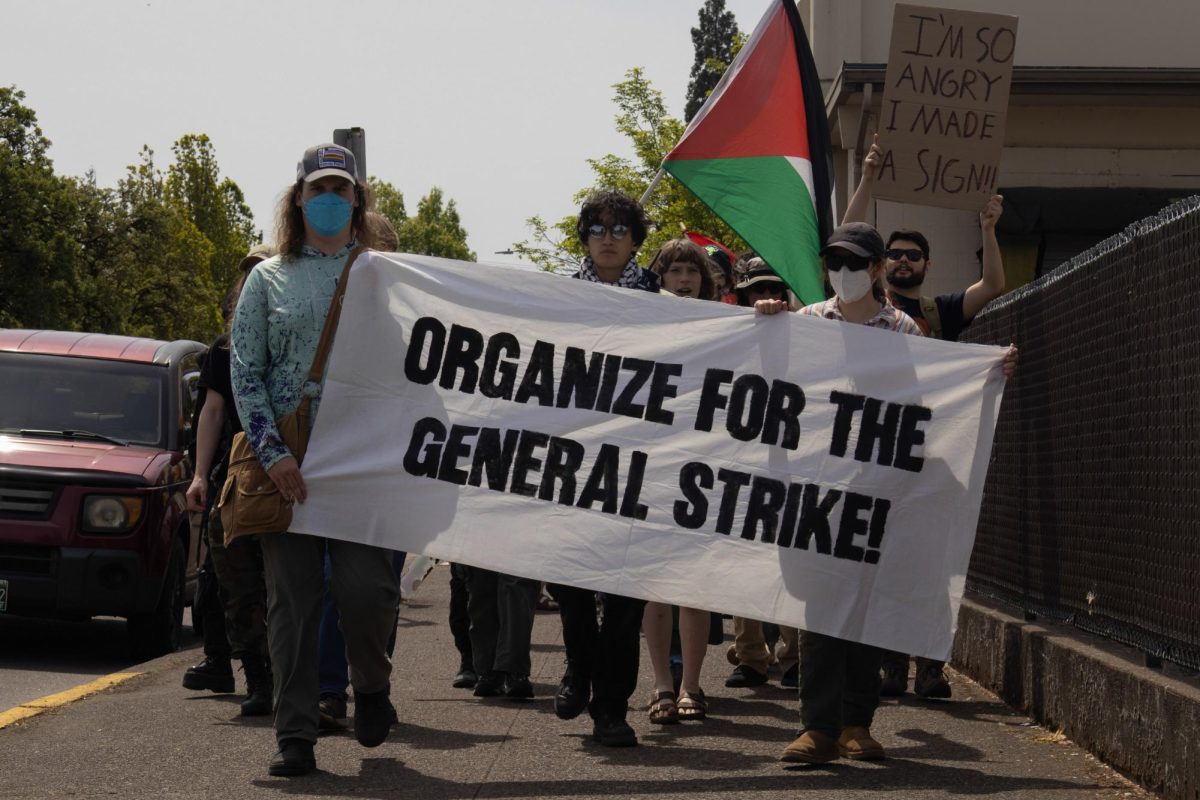
Over one year after the dismantling of Oregon State University’s student-led pro-Palestine encampment, activists accuse the university of remaining complicit in genocide abroad and repressing democracy at home.
The encampment’s original demands were for divestment, disclosure and freedom of speech, according to a statement sent via direct message from the Oregon State University Palestine Solidarity Coalition.
In spring 2024, OSU students set up a pro-Palestine encampment in the Memorial Union Quad, joining a nationwide wave of protests against the United States’ support of Israel and the complicity of universities across the country in what some activist groups consider to be genocide in Gaza. Organized by OSUPSC, the encampment continued throughout the spring and into the summer, ending in June of 2024. Following the disbandment, OSU released a statement laying out an action plan.
Following the encampment, the university put forth a proposal to address these demands, forming four groups: the Task Force on Responsible Investing, the Task Force on Responsible Procurement, the Advisory Committees on Library Resources and the Advisory Committees on Scholarly Events.
According to OSUPSC, the goal of each of these groups, respectively, has been to examine OSU’s investment and purchasing policies, to create a library guide about the region and to create programming (e.g. speakers, art exhibits and concerts) related to Palestine and Israel.
“We say with absolute certainty that none of the above proposals would have been put forward at all if the OSUPSC had not started the encampment and refused to comply with OSU’s threats to remove it,” OSUPSC wrote.
According to a June 2025 letter from Dan Larson, vice president for student affairs, and Scott Vignos, vice president and chief diversity officer, these groups met regularly over the course of the previous academic year to advise OSU’s response to “the crisis in Gaza, Israel and the region.”
Members of these groups were selected by the university, and were made up of students, faculty and staff according to OSU’s website.
While OSUPSC noted that the Task Force on Responsible Investing has been the closest thing to what student organizers have demanded of the university, progress of the task forces has been slow. Deadlines continue to be pushed back and the work of these committees and task forces holds no binding power.
“The one straightforward action that OSU has taken is to start releasing investment reports for each quarter,” wrote OSUPSC. “Students have been asking for more transparency in regard to investments since at least 2019, when OSU was forced to divest from fossil fuel companies by student activists, but refused to reveal their investment reports.”
OSUPSC outlined what accountability from the university would look like from their perspective.
“OSU would apologize for criminalizing, surveilling, and disciplining students who stood up for not only human rights but human life itself,” OSUPSC wrote. “OSU would immediately demand that their investors divest from companies complicit in the apartheid state of Israel. OSU would also reinstate the roles of ASOSU members and student employees who were fired for their alleged connection to the encampment, allow the ASOSU to reform of their own accord, and invest them and (the) faculty senate with binding powers to change investment and procurement policies at the university.”
More information on OSUPSC can be found on their instagram @palestineosu. Information on the university’s response can be found on OSU’s Leadership website.