






































































































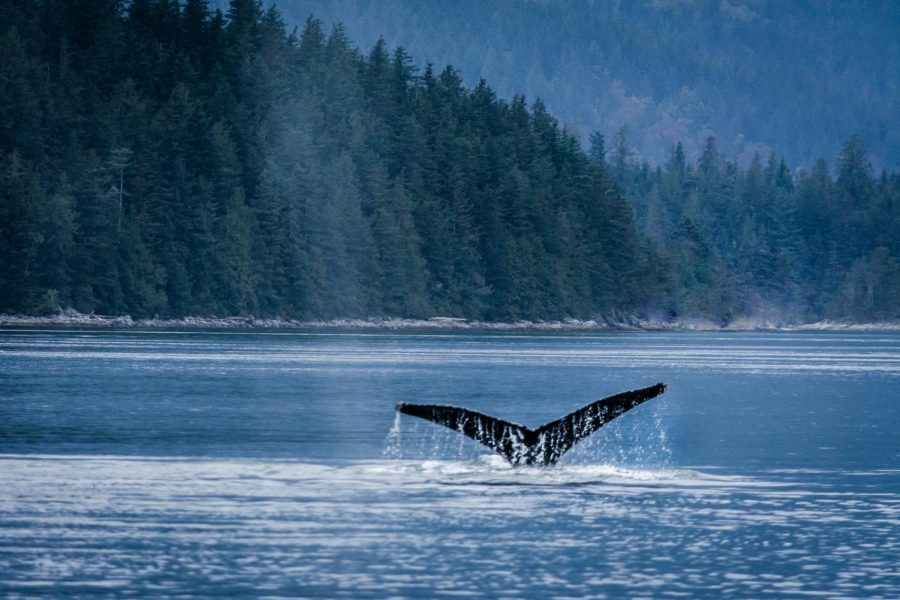
Bundle up and gather around the shore to see gray and humpback whales on their southern migration from mid-December to mid-January.
Recommended whale watching spots include Cape Fowlweather, Yaquina Head and Cape Perpetua, according to Jim Sumich, a researcher at Oregon State University’s Marine Mammal Institute who taught Oregon Whale Watch volunteers.
Nye Beach turnaround is another good location for sighting whale blows, according to an email from Renee Albertson, a senior instructor at OSU’s Department of Fisheries and Wildlife who also led OWW volunteers.
Oregon Whale Watch interpreters will be available from Dec. 27 through Dec. 31 across 15 locations shown on their website.
Albertson recommends binoculars and a high vantage point due to the whales being farther from shore during their southern migration.
According to Sumich, gray whale blows tend to be more bush-shaped, whereas ones from humpbacks are more columnar.
Weather conditions may impact the visibility of the blows throughout the season.
“If you have a gray blow against a gray sky against a gray ocean, then it will be hard to see anything,” Sumich said.
“Researchers estimate that 13,000-plus gray whales now live in the eastern north Pacific area,” OWW’s website states. “About 30 whales per hour migrate past the Oregon coast during the peak southbound migration.”
Both whale species are heading south in order to reach their breeding grounds, with gray whales traveling to offshore Baja California. The humpbacks’ destinations are California, mainland Mexico and the Revillagigedo Islands.
Between 2019 and 2023, the total gray whale population and calf count decreased significantly, according to the National Oceanic and Atmospheric Administration.
Sumich said that the reason for the mass gray whale deaths is unclear, but may include decreased pregnancy and higher abortion rates.
Another factor may be starvation from decreased phytoplankton abundance caused by changing coastal upwelling. Gray whales may be more impacted by these changes due to their proximity to the coast.
Sumich described that the humpback population is more difficult to monitor due to being farther out than gray whales.
The frequency of stranded gray whales is lower during the winter, according to an email from Jim Rice, the stranding program manager at MMI.
“In Oregon, gray whale strandings are comparatively uncommon during the southern migration, which is primarily during December and January,” Rice said. “Since 2005, 12 (20%) of the 61 gray whales that are known to have stranded, did so during those months.”
NOAA defines a stranding as a marine mammal on shore that needs medical assistance or can not re-enter the ocean through its own means. Additional guidelines can be found on NOAA’s website.
In the event that you observe a stranding, you can report it to the West Coast Stranding Hotline at 1-866-767-6114.
The gray whales will begin their northward migration in late March. Between May and October, around 200 will remain close to shore to feed.
