











































































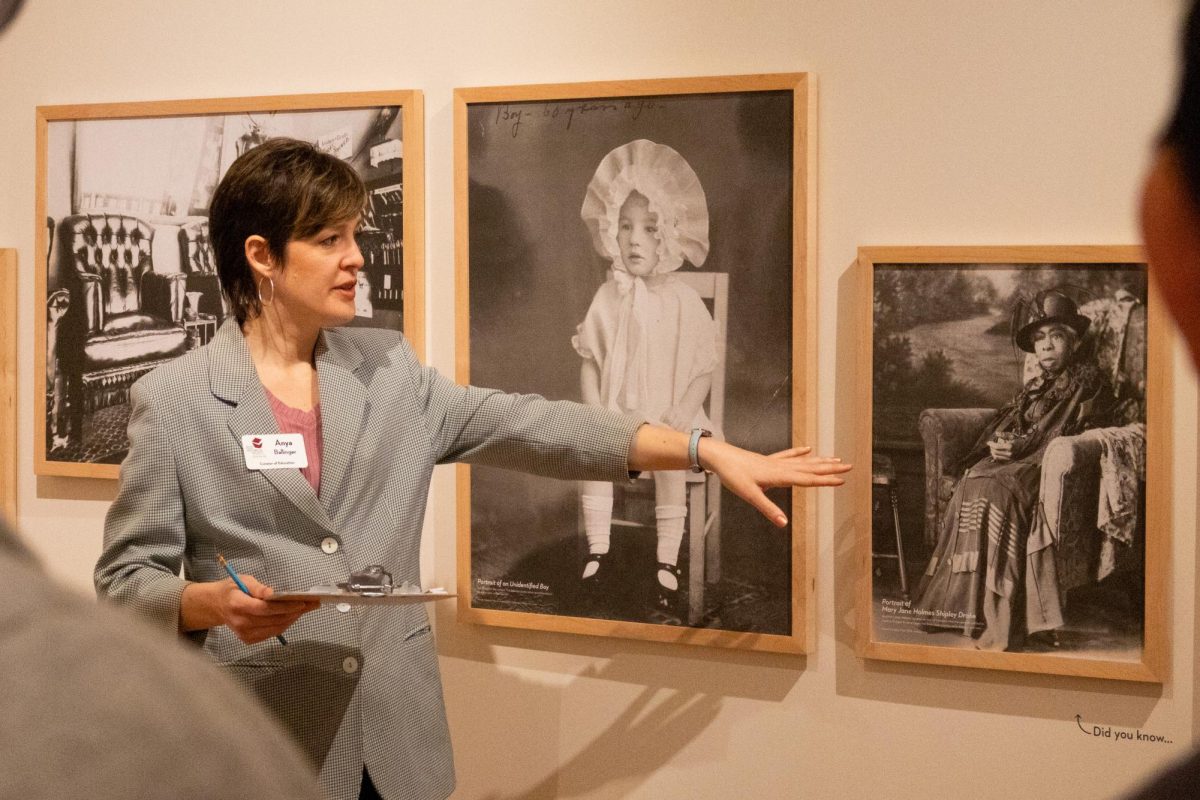
For years, Black history has existed largely in the margins of local stories. Now, that presence is coming to the forefront through the Corvallis Museum’s Black History in Benton County tour.
“Our job as the Benton County Historical Society is to tell the stories of the people of Benton County, and for a long time, there wasn’t a lot of attention paid to the Black people who have lived here over the centuries,” said Anya Ballinger, curator of education at the Corvallis Museum. “However, Black people have lived here since Benton County became a county.”
Ballinger partnered with Oregon Black Pioneers and the Linn-Benton National Association for the Advancement of Colored People to develop the forty-five minute guided tour, which walks visitors through the museum while highlighting the lives and contributions of Black pioneers who traveled the Oregon Trail, settled in the area and helped shape local communities.
The tour centers on the stories of three Black Benton County settlers — Louis Southworth, Mary Jane Holmes and Letitia Carson — while contextualizing their experiences within the broader national debate over slavery during the mid-1800s.
Southworth arrived in Oregon as an enslaved man and bought his freedom playing the fiddle; Holmes secured her freedom in Holmes v. Ford, the only slavery trial adjudicated in Oregon; and Carson traveled West with her White partner, and after his death successfully sued to claim land and compensation, making her Oregon’s first Black woman to own land.
Ballinger explained that when Oregon became a state in 1859, voters declared it a free state while simultaneously approving an exclusion clause in the state constitution that prohibited Black people from living in Oregon.
“Despite that, white folks would bring enslaved people with them, because there wasn’t a lot of enforcement,” Ballinger said.
According to Ballinger, visitors’ reactions to this history vary. Some are shocked to learn about Oregon’s exclusion laws, while others arrive with prior knowledge and want to deepen their understanding.
“Although this particular tour focuses on the 1840s, 1850s and 1860s, it’s important not to think about racism as something that ended in the past or after the Civil War,” Ballinger said. “We have to look at the ripple effects of how the legacy of those exclusion laws still impacts who lives in Oregon today, who has opportunities in Oregon and who owns land here.”
The tours will be offered through April, with upcoming dates including 5:30 p.m. on Feb. 17.
Additional tours may be scheduled upon request by contacting the museum.
The tour is free, though a $5-10 donation is suggested. All proceeds support educational programming at the Benton County Historical Society. Registration is available through the Corvallis Museum’s website.
“I hope that when people walk away, they’re able to look back on the founding of Oregon and know that Black people have been living here since the beginning — since before we were a state,” Ballinger said. “I hope that gives people a sense of belonging. When we ask who belongs in Oregon, we should believe that Black people belong here as much as anyone else.”
“When you ask, ‘What does a pioneer look like?’” Ballinger added, “perhaps you’ll think of Letitia Carson or Louis Southworth.”
