




































In Newport, Oregon, a team of scientists, engineers, construction workers and community members gathered on May 15 to welcome back the bones of a blue whale that had washed ashore more than a decade ago.
“After so much hard work, so many partnerships, so many complexities to see it all come together in — essentially — what will be two days is stunning,” said Lisa Ballance, director of the Marine Mammal Institute and interim executive director of the Hatfield Marine Science Center.
The journey of the blue whale from beach to display started back in November 2015 — the first recorded blue whale to strand on Oregon’s shore since the days of Lewis and Clark in 1804.
In 2015, the Marine Mammal Institute, a facility that makes up part of Oregon State University’s Hatfield Marine Science Center campus, was alerted to the presence of a beached 75-foot-long blue whale in Gold Beach, Oregon, just south of Newport.
The institute saw the appearance of the already perished whale as a rare opportunity to display some of its bones on campus as both a draw for students and tourists, as well as for research purposes. The specimen’s additions would mark one of the few blue skeletons on display in the country.
After bringing the remains back to Hatfield and thoroughly examining the carcass of the whale, a team led by former Director of the MMI Bruce Mate began the process of stripping the bones of excess tissue. They did this by dipping the bones into the Yaquina Bay for months at a time and letting the local sea life eat away at the remains.
According to Jim Rice, the director of the Oregon Marine Mammal Stranding program as well as a member of Mate’s team throughout the project, the initial anchoring of the bones as well as regular monitoring of the tissue’s decomposition was done with the help of divers from the Oregon State Aquarium.
Following that, the remains were stored on campus, where they remained in storage for several years.
That is, until Dinosaur Valley Studios, a company based in Alberta, Canada, that specializes in skeletal reconstructions, prop designs and fossil fabrications, reached out. More specifically, the company’s president, Frank Hadfield, did.
After Hadfield reached out expressing interest in the project, the team was able to raise enough money to send the specimen to Canada for reconstruction.
“It’s art, science and engineering,” Hadfield said in reference to the process of reconstructing the whale’s skeleton.
While much of the skeleton remained intact, 5-8% of the entire skeleton required replication because of damage. Including the entirety of the creature’s skull and 18-foot-long jaws.
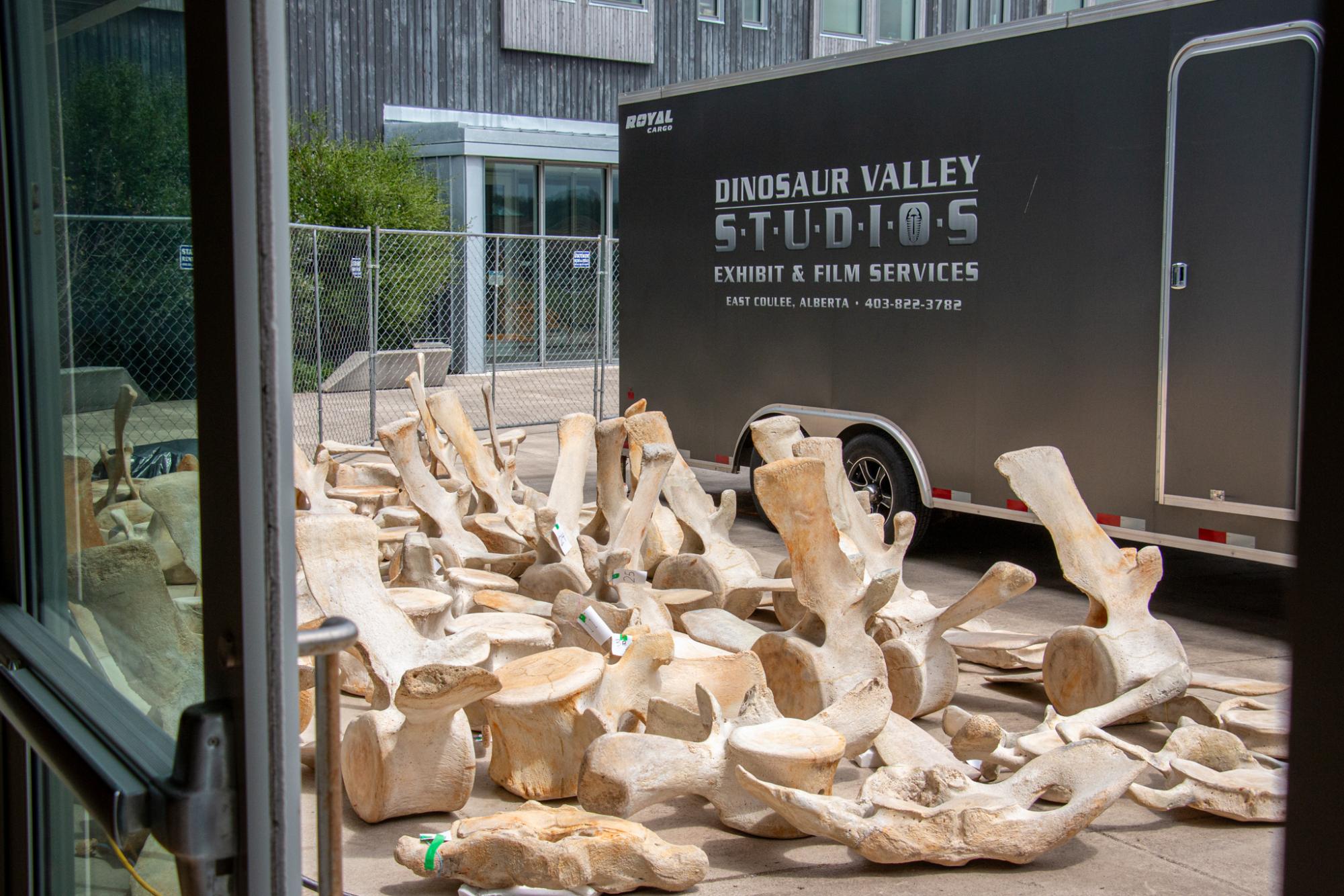
As Dinosaur Valley Studios began the process of fabricating and replacing various damaged parts of the skeleton, multiple conclusions were drawn after examining the specimen.
For instance, the bones of the whale showed signs of scoliosis, an abnormally fused ribcage and the heavily damaged skull, presumed by the team to be the cause of the creature’s death.
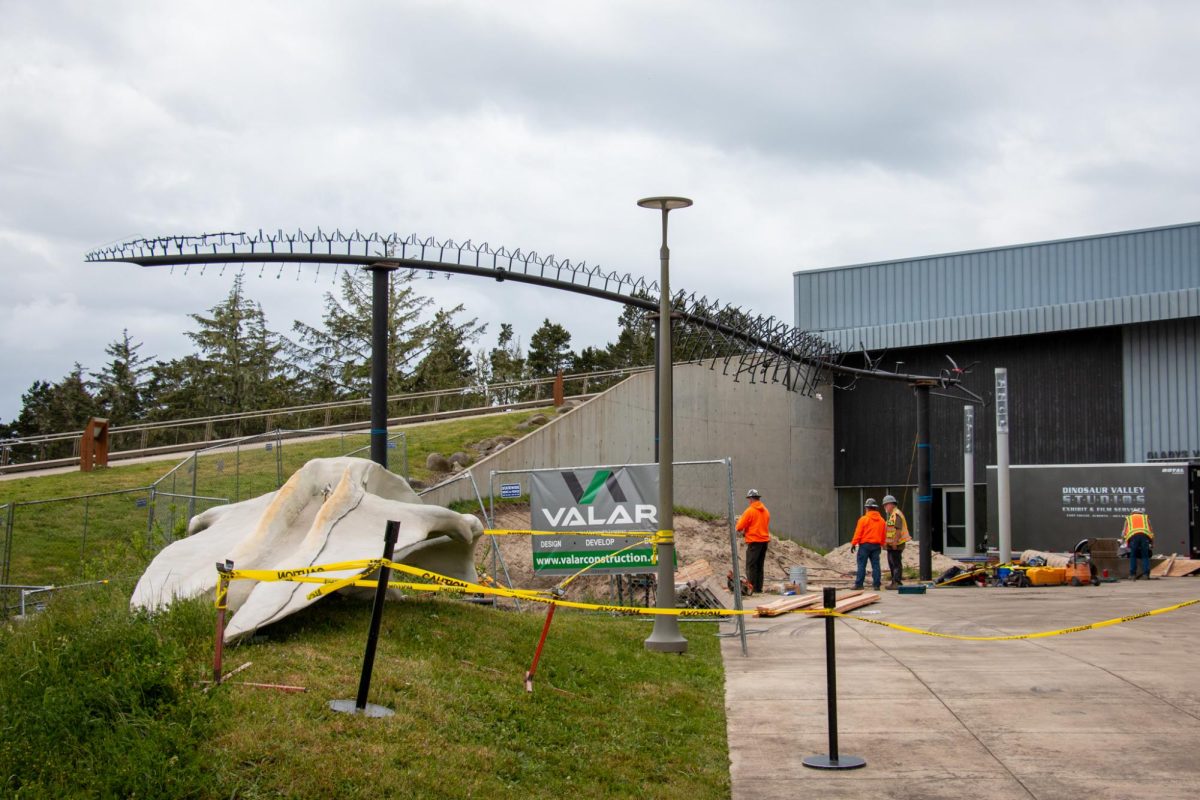
Now, the fully completed skeleton is displayed on an armature outside of the Marine Studies Building at OSU’s Hatfield campus and is accessible to students and the public alike.
“It is surreal … it’s been a better part of a decade since I saw the bones up close and had the experience of pulling them off the beach back in 2015,” Rice said in reference to the fully completed skeleton.
The skeleton’s display allows for parts to be easily removed, allowing faculty and students to use the specimen’s bones for research.
The construction of the skeleton, courtesy of Dinosaur Valley Studios and VALAR Construction, began back in April. VALAR Construction’s Founder and CEO Norm Feris noted that the construction of the skeleton and the armature meant to hold it up has gone relatively smoothly, which he sees as a virtue for a project this ambitious.
“We’ve done exhibits before, but this is one of a kind for sure,” Feris said.
While the exact cost of the construction has yet to be properly calculated, the team estimates that the figure lies somewhere between $550,000 and $600,000, not including sizable contributions from various donors.
“(People) are gonna feel in awe of what’s in front of them,” Ballance said regarding her hopes of what visitors take away from seeing the skeleton. “I’m hopeful that that awe might inspire or open doors to people to think a little more about science.”
In reference to his own hopes for the project, Hadfield said, “Well, first I hope it doesn’t fall down.”