






































It’s a new year, but for Oregon State University students and faculty it’s also an opportunity to reexamine the past.
The 6,400-square-foot Center for Materials Cultures Research in Art, Archaeology, and Indigenous Studies is expected to open early winter term on the fourth floor of Fairbanks Hall. The CMCR will feature classrooms and offices with a focus on traditional crafting, 3D modeling and storytelling about objects.
Funding for the project came in part from the National Endowment for the Humanities Challenge Infrastructure and Capacity Building grant. The project is set to cost $4.3 million, according to Denise Neu, director of Capital Project Delivery.
Fairbanks was recently remodeled in 2021, during which Capital Projects noted the potential to use the fourth floor. The floor had been sealed from public access since the 1960s, but the addition of an elevator made using the space viable again.
David Lewis, assistant professor of archaeology and anthropology, recalls previously having a class on an upper floor of Fairbanks that was relocated due to accessibility issues.
“When they put the elevator in, it made it possible to teach really any class up there,” Lewis said.
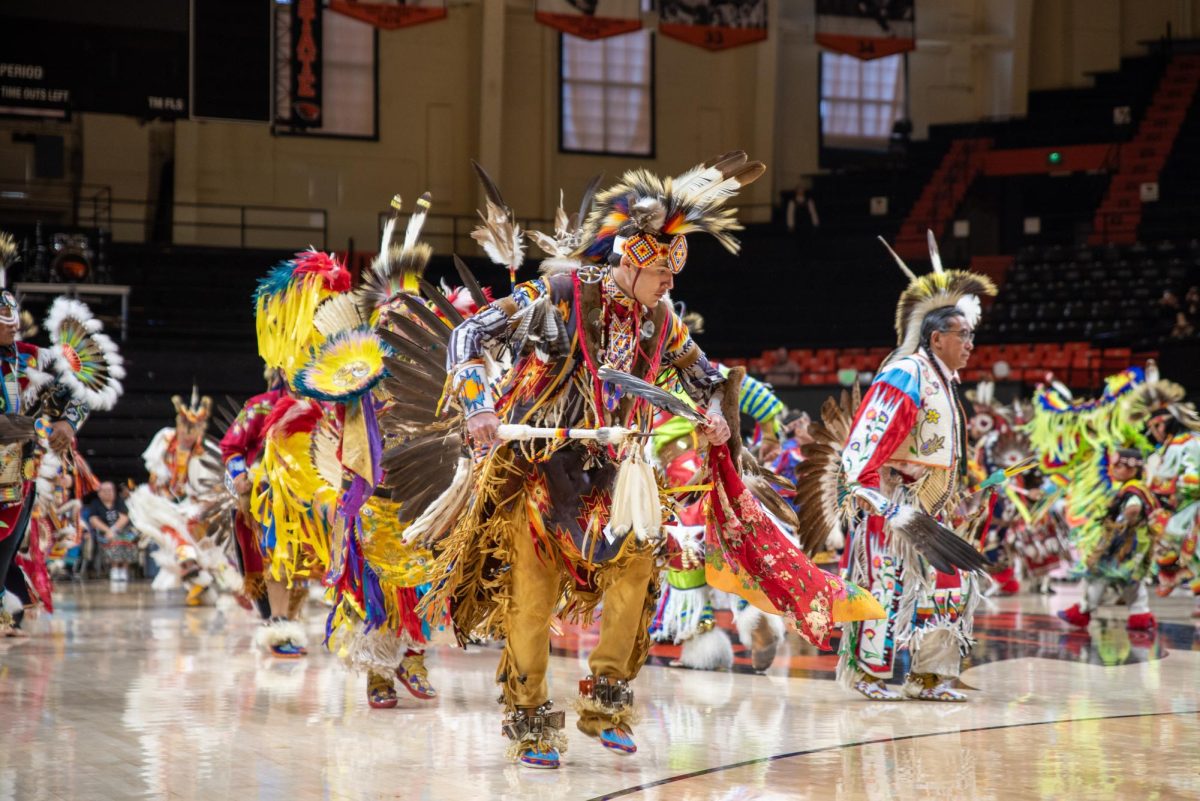
The classes and research in the CMCR will focus on art, archaeology and Indigenous studies, but it “is open to anyone working with objects, from 3D scans of ancient stone tools to beadwork for Pow Wow regalia to book making,” Director of CMCR and Associate Professor of English Megan Ward said in an email.
Associate Professor of Anthropology Loren Davis is one of the faculty members who will use the new 3D scanners for research and teaching. He plans to teach a class called “Introduction to 3D Scanning and Archaeology” when the center opens.
The class will teach undergraduate students to scan objects, build digital collections and tell stories about the objects. The idea is to eventually use the lab to give the public easier access to Oregon State University’s collection of archaeological artifacts via webpage exhibits.
“By finding ways to share more information about archaeological collections, we can expose the things that often are locked away in boxes and warehouses and people don’t get to see them,” Davis said.
Davis is also focused on connecting the archaeological objects in OSU collections with the stories of the cultures that created them. For his research, this means working with the Nez Perce tribe to tell the stories of their ancestors through artifacts found at the Cooper’s Ferry Site in Idaho.
“What we want to do is use three-dimensional scanning to capture the shape and form of objects and then demonstrate how you can study them by their shape, but also get the people involved that are related to the objects,” Davis said.
While archaeology is one use for the CMCR, there will also be a new classroom space for Indigenous studies. According to Lewis, the space will be used for classes of under 25 students, faculty meetings and workshops involving beading and weaving.
In the past three years, since Indigenous studies was added as a minor, it has grown to more than 70 students, according to Lewis.
The CMCR will give Indigenous studies a new space outside its current home in Waldo Hall.
“It’s coming up at the same time as we are developing Indigenous studies here as a minor, so I think we can sort of grow into that more in terms of the functions and our abilities to do programming up there,” Lewis said.
Davis also envisions a variety of future uses for the center.
“We anticipate that we want this to grow not just to be about archaeology, but to be about anything. Anything that has a shape you can tell a story about,” Davis said.