























































Six research teams from Oregon State University have been selected to be among the first projects to run on the new supercomputer in the Jensen and Lori Mills Huang Collaborative Innovation Complex when it opens in 2027.
The seed fund program offered by the newly created Research Computing Office gives each team selected 50 thousand dollars and access to the supercomputer to work on solutions to complex science and engineering problems.
These projects are known as “hero runs” because they will use large amounts of computing resources at one time to solve very complex problems.
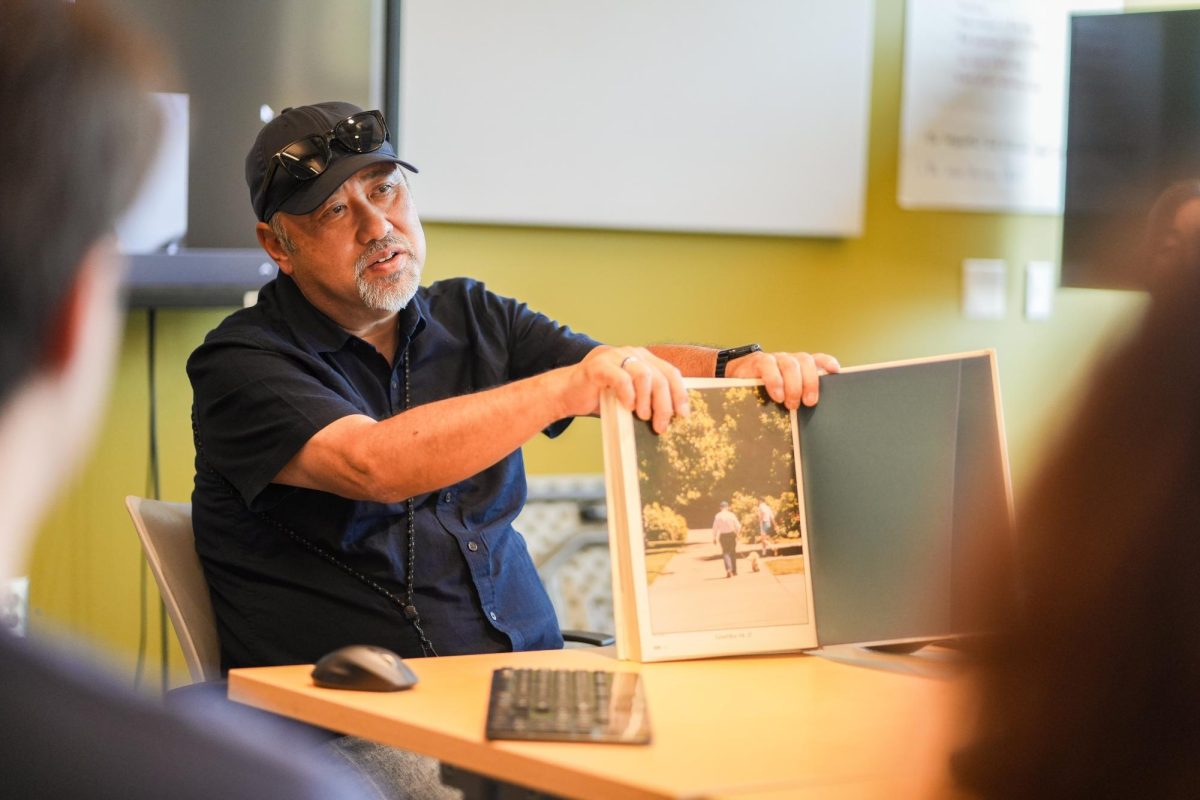
“The thought was, we create this seed program to incentivize people to think bigger about their research,” said Todd Palmer, senior advisor and chief scientist for research computing. “Like, given where you are now, what big problem could you address in a year that would make good use of our computing resources?”
The six projects were selected in three different colleges within Oregon State University. Those being the colleges of Science, Engineering, and Earth, Ocean and Atmospheric Sciences.
Benjamin Dalziel, a theoretical ecologist in the College of Science, plans to use the computer to model what he calls city-scale immune systems.
The idea behind the project is to find ways for populations of cities to slow the spread of infectious diseases such as COVID or influenza. This would be done using AI-powered forecasting models, which would allow cities to sense and respond quickly to outbreaks.
“What if instead of amplifying the spread of pathogens, cities could act as intelligent systems that could attenuate spread, or slow spread or even stop it?” Dalziel said.
The key lever for controlling spread that Dalziel and his team are considering right now is population movement. The way they intend to model this is with the use of a digital twin, which acts as a simulated city.
“Once we’ve built the digital twin, we want to use it to try to discover new movement patterns for cities where people are subtly shifting the timing of when they do things like go to the grocery store in ways that reduce transmission, but don’t severely impact daily life,” Dalziel said.
Through the hero run, the team hopes to create models of movement in all 241 incorporated cities in Oregon that will then be made publicly available in the next few years.
While Dalziel’s seed fund project may be focused on human health, Jesse Rodríguez, assistant professor of mechanical engineering, plans to focus on another critical topic –- energy.
Rodríguez, alongside his team of students, which comprises the Strongly Coupled Systems Lab, wants to use AI to create a foundational model of disruptions in nuclear fusion so that teams in the future can better maintain their fusion reactors.
The team plans to do so by analyzing decades’ worth of data collected from the nuclear reactor known as DIII-D, run by General Atomics and the U.S. Department of Energy in San Diego.
According to Rodríguez, disruptions in nuclear fusion occur due to turbulence, which is random motion in the plasma that can cause instabilities.
He compared it to turbulence on a plane, but much more extreme.
“These turbulent fluctuations can couple into these resonant frequencies for instabilities, like the resonance frequency of a wing, but much more complicated,” Rodríguez said. “It essentially just causes the perturbation or distortion of the magnetic field that you’re using to actually confine the plasma.”
Failure of the magnetic field that contains the plasma can potentially cause damage to the reactor when very hot plasma from the core comes in contact with plasma-facing structures.
With the model, Rodríguez and his team hope to be able to predict when disruptions may occur, so that they can prevent issues.
Additionally, the team hopes that their work can help reactor sites get to a point where the amount of energy they put into the reactor is less than the energy they get out.
“Just shutting it off is a good thing before a disruption, but also the hope is that we’ll be able to actually steer the reactor dynamically to avoid disruptions and still maintain a high plasma pressure overall, so that we can achieve net fusion gain,” Rodríguez said.
Rodríguez would like to eventually share the model with other fusion energy scientists, allowing them to modify it for the specific reactors they work with.
Along with Rodríguez and Dalziel, there will be four other hero runs. Those additional runs include:
“Using AI to Better Understand the Physics of Wave Breaking,” “Enabling Massively Parallel Exact Quantum Dynamics Simulations,” “Toward a Geospatial AI Foundational Model for Oregon” and “Ultrafine Spatial Modeling of Weather and Climate.”
Students interested in finding out more about the “hero runs” and their progress can look at the Huang Complex Seed Fund webpage.
The Research Computing Office hopes to renew the seed fund program again in the future for new applications.
Currently, the Research Computing Office is working on a bioengineering and biosciences program that teams from universities across Oregon can apply to.
Palmer, for his part, views the new Research Computing Office and the supercomputer as a “generational opportunity to change the way things work at OSU.”
“We get to reinvent this in a way that scales better for the future for OSU, that helps us steward our resources really well, and that helps us share experiences across a whole variety of communities who use these machines,” Palmer said.