






























































































The federal government released its blueprint for healthy eating, reaffirming long-standing nutrition advice while signaling a shift in priorities from the White House’s “Make America Healthy Again” movement.
Issued Jan. 7 by the U.S. Department of Agriculture and U.S. Department of Health and Human Services, the 2025 – 2030 edition of the Dietary Guidelines for Americans serves as the foundation for federal nutrition policy, public health programs and dietary guidance for the general public.
While the new recommendations largely echo past guidelines, they place a greater emphasis on animal proteins and full-fat dairy — a departure from conventional nutrition messaging.
“Under President Trump’s leadership, we are restoring common sense, scientific integrity, and accountability to federal food and health policy — and we are reclaiming the food pyramid and returning it to its true purpose of educating and nourishing all Americans,” the guidelines’ introduction states, written by Agriculture Secretary Brooke Rollins and Health and Human Services Secretary Robert F. Kennedy Jr.
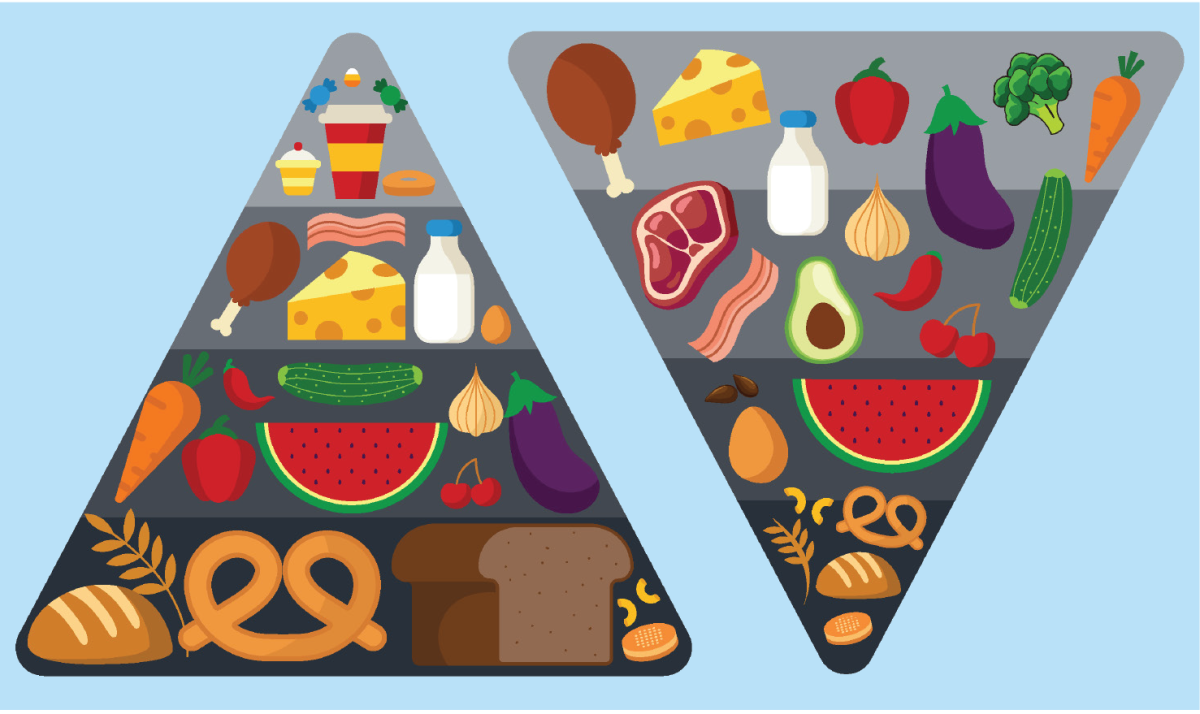
The updated guidelines feature an inverted food pyramid, placing protein, dairy and healthy fats at the top, with whole grains at the bottom.
Some elements of the new guidelines — such as encouraging whole foods like fruits and vegetables and limiting sugar, ultra-processed foods, sodium, saturated fats and refined carbohydrates — align with scientific literature, according to an email from Melinda Manore, a dietitian and Oregon State University nutrition professor.
Other aspects, however, raise concerns.
“The difficulty is their emphasis on ‘meat,’ which is high in saturated fat, and fats from butter and beef tallow, which are also high in saturated fat,” Manore said.
The guidelines prioritize protein from animal sources at every meal while also recommending that saturated fat make up no more than 10% of daily calories.
Manore said the two recommendations are difficult to reconcile, as animal products tend to be higher in saturated fat, making it challenging to center meals around animal protein while staying within recommended limits.
“They say, ‘Consume a variety of protein foods from animal sources.’ Well, when people see that, somebody might say ‘Oh, I can have three burgers instead of one,’” Manore said. “I think a lot of nutrition professionals are objecting to the inconsistencies in this. Then to go on and say less than 10% of calories should come from saturated fat — that’s confusing.”
The new guidelines also place a stronger emphasis on protein overall, recommending 1.2 to 1.6 grams of protein per kilogram of body weight per day, an intake level typically reserved for athletes.
By comparison, the recommended dietary allowance for the average adult is 0.8 grams of protein per kilogram of body weight.
For example, an average 155-pound (about 70 kilograms) man needs about 56 grams of protein a day. Meeting this goal could look like a cup of yogurt, 3-oz of lean meat, a cup of dry beans or an 8-oz glass of milk, according to the American Heart Association.
While protein is an important part of a healthy diet, Manore said it should not overshadow other nutrients, noting that most Americans already consume adequate amounts of protein, while not getting enough fiber found in whole grains and cereals.
She added that the body has no storage capacity for protein, meaning any excess is either used for energy or converted and stored as fat.
Manore also identified what she described as “basic nutrition errors” in the guidelines, such as labeling xylitol as a nonnutritive sweetener, when it is a sugar alcohol and does have kilocalories, or recommending fats that lack essential fatty acids while categorizing them as sources of those nutrients.
She further pointed to contradictions throughout the document, including encouraging fiber intake while placing whole grains at the bottom of the pyramid and limiting saturated fats while emphasizing animal-based foods.
“Americans are already confused about nutrition,” Manore said. “We don’t need to make it worse by having the wrong information.”